
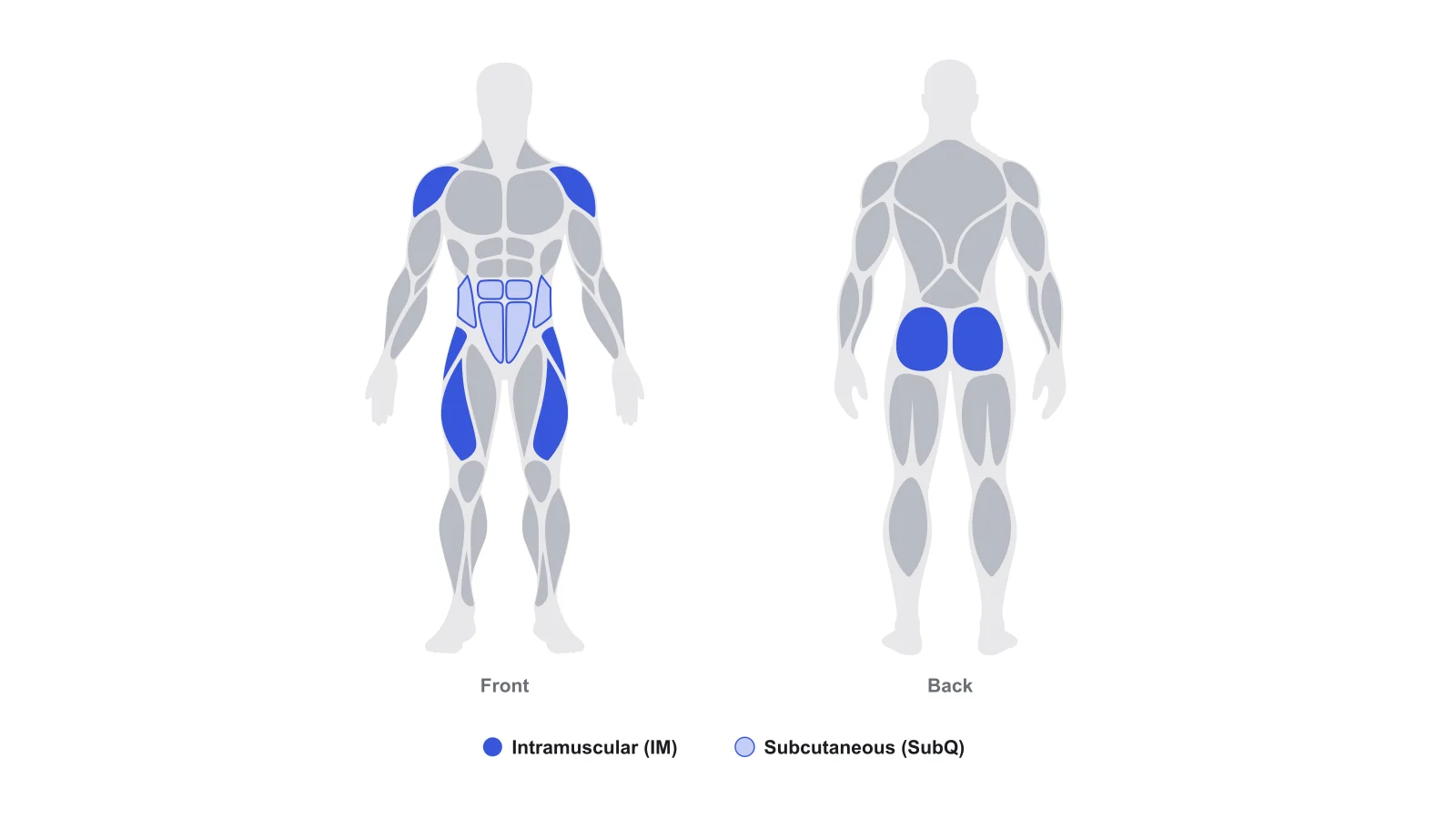
What are the main TRT injection sites?
TRT injection sites fall into two groups. Intramuscular (IM) sites are large muscles: the side of the hip (the ventrogluteal area), the upper outer buttock, the outer thigh and the shoulder. Subcutaneous (SubQ) sites are places with a layer of fat under the skin, mainly the belly.
Your product and your prescriber decide which group you use.
This page is a map, not a lesson in injecting testosterone at home. If you are new to giving yourself shots, ask your prescriber’s nurse or a pharmacist to show you in person and watch your first one. Never change your route, schedule or amount without your prescriber.
Where are the intramuscular testosterone injection sites?
The body map at the top of this page shows the twelve sites the TRTracker app offers. IM sites are in dark blue and SubQ sites in light blue. Your prescriber decides which ones suit you.
Ventrogluteal (side of the hip) is a muscle on the side of the hip, below the bony ridge of the pelvis. Nursing research favours it over the upper outer buttock for IM shots. It is farther from the sciatic nerve, has fairly few veins and has a thinner layer of fat over it.
In a review of 17 studies, shots here were linked to less pain, bleeding and bruising (hematoma) than shots in the upper outer buttock. It is easier to find with a nurse’s help than on your own.
Dorsogluteal (upper outer buttock) is the classic “glute” shot. The DEPO-Testosterone label says to inject deep in the gluteal (buttock) muscle.
Injury to the sciatic nerve has been reported with shots in this area. That is one reason the ventrogluteal site is often preferred. It is also hard to reach on yourself.
Vastus lateralis (outer thigh) is the large muscle on the outside of the thigh. It is easy to see and reach while sitting, which is why many people who inject themselves use it.
Deltoid (shoulder) is the rounded muscle at the top of the upper arm. It is small, so it suits only small volumes, and nerves and blood vessels run close to it. Our mL calculator shows how much liquid your dose makes.
Where do you inject subcutaneous testosterone?
The abdomen is the fat around the belly, away from the navel and from scars. It is the only site named in the Xyosted label. It was also the site used in a published study of weekly SubQ cypionate.
The Xyosted instructions say to use the left or right side of the belly and to stay at least 2 inches from the belly button. They also say not to use other areas of the body. That rule is specific to Xyosted, and other products may have different rules.
The love handles (flank) are the soft area at the side of the waist, just above the hip bone. They are one of the SubQ sites in the TRTracker app, but the Xyosted label allows only the belly. No testosterone label or guideline we reviewed names the flank for SubQ use, so ask your prescriber whether it suits your product.
Front of the thigh. Some prescribers allow it for SubQ use. Ask yours before using it.
Splitting sites by side, and the belly into zones, makes rotation easier. Here are the twelve sites in the app, grouped the way its site picker groups them:
How do IM and SubQ injection sites differ?
Intramuscular shots use a longer needle that passes through the skin and fat into muscle. Testosterone cypionate is given as an ester (a slow-release form) in oil. The label says esters in oil injected into muscle are absorbed slowly from the oil.
Its half-life after an IM shot is about eight days. Half-life is the time it takes for half of the dose to leave your blood. Subcutaneous shots use a short, thin needle and stop in the fat under the skin, so the oil sits in fat.
Your product sets the route:
- The DEPO-Testosterone (testosterone cypionate) label says it is “for intramuscular use only.” It also says to give it deep in the buttock muscle.
- Xyosted is a testosterone enanthate auto-injector approved for SubQ shots in the belly. In a 52-week study of 150 men, 92.7% had an average total testosterone in the 300 to 1,100 ng/dL range at week 12.
- Some prescribers use cypionate or enanthate vials for SubQ shots. That is outside the cypionate label, so it is the prescriber’s decision. Two studies in transgender men support it, covered in our guide to subcutaneous testosterone injection.
| Intramuscular (IM) | Subcutaneous (SubQ) | |
|---|---|---|
| Where it goes | Into muscle, through skin and fat | Into the fat layer under the skin |
| Typical sites | Ventrogluteal, upper outer glute, outer thigh, shoulder | Abdomen (the labeled site); other areas only if your prescriber allows |
| Needle | Longer, to reach muscle | Short and thin |
| Product examples | DEPO-Testosterone (label: gluteal muscle) | Xyosted auto-injector (label: abdomen) |
| Who decides | Your prescriber, from your product and needs | Your prescriber, from your product and needs |
Whether an IM needle reaches the muscle depends on two things. One is the needle’s length, and the other is how thick the fat is over the muscle at that site. That is why studies compare sites by fat thickness.
It is one more reason to have a nurse or pharmacist set you up. Our guide to TRT needles covers the supplies.
How do you find the right spot for each site?
Don’t try to find a site from a diagram or a paragraph. Nurses place IM shots using landmarks on the body, and those are best taught by hand, in person, and checked. They are easier to find on someone else than on yourself, which is why some people use only the sites they can see and reach.
When a nurse or pharmacist shows you, ask them to mark the area, watch you find it, and tell you which sites to avoid. If you can’t find a landmark with confidence, don’t guess. Use a site you have been shown, and ask for another lesson.
Drawing up the dose is also best learned in person. Our guide to drawing up testosterone lists what to ask.
Do IM and SubQ injections feel different?
Many people find SubQ shots less uncomfortable, because the needle is shorter and thinner. In a study that looked back at the records of 63 transgender men, all 22 who switched from IM to SubQ preferred SubQ. None preferred IM.
In the Xyosted study, more than 95% of men reported no pain from the shots. Others prefer IM because it’s what they know, or because it suits larger volumes.
Pain also depends on things a body map can’t show. These include how cold the oil is, how fast it goes in, how tense the muscle is, and whether the alcohol has dried first.
The Endocrine Society lists pain at the injection site among the effects of IM testosterone shots. Your nurse or pharmacist can help if shots hurt more than you expected.
Do testosterone levels differ between IM and SubQ?
They can, because the route and the schedule shape your levels between shots. In a small study of 11 transgender men on weekly SubQ cypionate, average testosterone stayed within the normal range across the week. The authors expect this to hold in men with hypogonadism (low testosterone) but did not test it.
With IM shots spaced further apart, levels typically rise to a peak and fall to a low point (trough) before the next shot.
That matters for blood work. If your route changes, the timing of your blood draw may need to change too, so ask your prescriber. Our guide to the TRT blood work schedule explains peak, trough and midpoint draws.
How do you rotate TRT injection sites?
Rotation means not using the same spot every time. Insulin shots have been studied far more. There, not rotating sites is linked to lipohypertrophy, a firm lump of thickened fat under the skin.
We found no study of this in testosterone. So treat rotation as a precaution borrowed from repeated SubQ shots in general. Spreading shots out means no one spot is used over and over.
A few simple patterns work well:
- Alternate sides every time: left, then right.
- Cycle through sites: for example left glute, right glute, left outer thigh, right outer thigh, then repeat.
- Use zones within a site: on the belly, move around rather than reusing one patch.
- Move a little within a site: leave a finger’s width or so from the last spot.
Here is one example of a four-shot cycle, to show the idea. It is not a plan for you. Which sites you may use, and how often you inject, are your prescriber’s call.
| Injection | IM example | SubQ example |
|---|---|---|
| 1 | Left outer thigh | Left side of the belly |
| 2 | Right outer thigh | Right side of the belly |
| 3 | Left ventrogluteal | Left side of the belly, a different spot |
| 4 | Right ventrogluteal | Right side of the belly, a different spot |
The pattern matters less than sticking to it. The easiest way is to record each shot: the date, the site and the side. It also helps when you talk to your prescriber about a sore spot or a lump, because you can say exactly when that site was last used.
To plan a rotation across the sites your prescriber approved, use our rotation planner. It suggests the next site on the same body map and shows when each was last used. Our injection how-to guide, linked above, covers the rest of the routine.
What does good injection hygiene look like?
These basics apply to every site:
- Wash your hands, and clean the site and the vial top with an alcohol pad. Let them dry.
- Use a new, sterile needle and syringe every time. Never share them.
- Don’t inject into skin that is bruised, scarred, red, swollen or tender.
- Put used needles straight into an FDA-cleared sharps container. Follow your local rules for getting rid of it.
What is normal after an injection?
Some reactions are common and usually settle on their own:
- Soreness in the muscle for a day or two after an IM shot, a bit like after a workout.
- A small bruise, especially if a tiny blood vessel was nicked.
- Minor skin reactions at a SubQ site, such as bruising, bleeding, redness or hardness. The Xyosted label lists these as injection site reactions, seen in 12.7% of patients over a year in its studies. It says to tell your provider about any side effect that bothers you or does not go away.
- A drop of oil or blood at the injection point when the needle comes out. Light pressure with gauze is enough.
Patterns tell you more than one bad day. If the same site is always sore, if bumps take longer and longer to fade, or if firm lumps don’t go away, look at your rotation first. Then mention it to your prescriber.
Our guide to pain and lumps after injections goes deeper.
Which injection-site problems should you call your prescriber about?
Mild soreness for a day or two is common. Call your prescriber or get medical help for:
- Redness, warmth or swelling that spreads or gets worse after a day or two, pus, or a fever: possible infection.
- Severe pain, numbness, or pain that shoots down the leg after a glute shot.
- A hard lump that grows, stays painful, or doesn’t go away.
- Coughing, trouble breathing, chest tightness, throat swelling or a rash soon after a shot. Get emergency help for these.
Coughing spells right after an IM shot are rare. The Endocrine Society says cough has been reported rarely after testosterone undecanoate shots, and even more rarely after enanthate and cypionate.
It says the cause is unknown. It has been blamed on tiny drops of oil reaching the small blood vessels of the lungs (pulmonary oil microembolization).
The testosterone enanthate label also lists rare reports of a brief urge to cough, coughing fits and breathing trouble right after a shot. It also lists rare severe allergy-like (anaphylactoid) reactions. The cypionate label lists allergic (hypersensitivity) reactions, including skin reactions and anaphylactoid reactions.
Note the site and date of any problem in your log, and tell your prescriber which site it was.
What should you ask your prescriber or nurse?
- Is my product meant for IM or SubQ use? Which sites can I use?
- Which needle and syringe should I use for each site?
- Can you show me how to find the site, and watch me do the first injection?
- What rotation pattern do you suggest?
- What would you want me to call you about?