
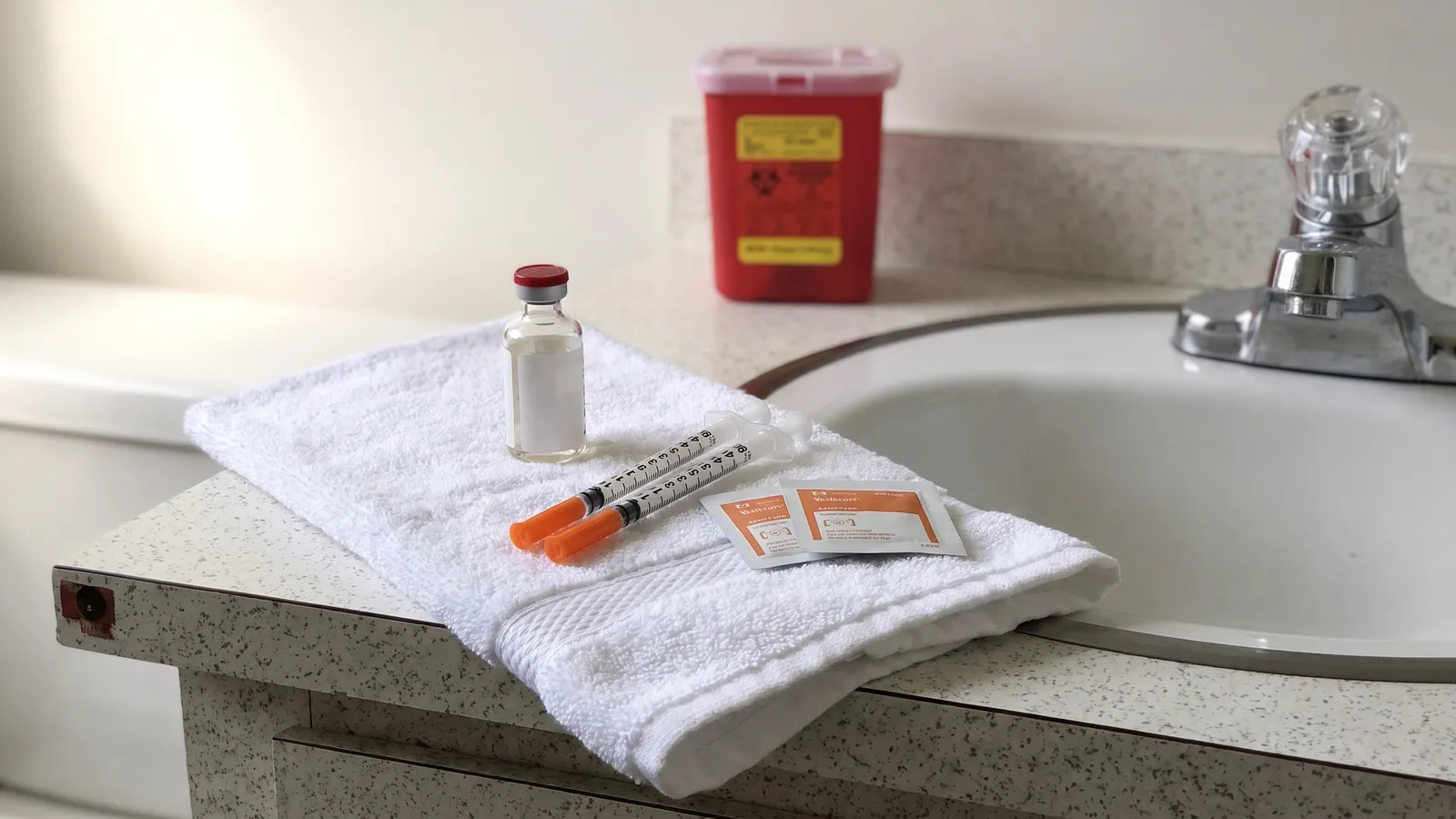
What is SubQ testosterone?
SubQ testosterone is a shot into the fat just under the skin, instead of into a muscle. The usual spot is the belly.
SubQ is short for subcutaneous, which means under the skin. IM, short for intramuscular, means into a muscle.
The medicine can be the same as for IM shots: testosterone cypionate or enanthate mixed in oil. What changes is where the oil sits. With SubQ, a small pool of oil, called a depot, forms in the fat.
The depot then lets testosterone out into tiny blood vessels over the next few days. For the whole routine, see the full guide to injecting testosterone. This page covers the SubQ route.
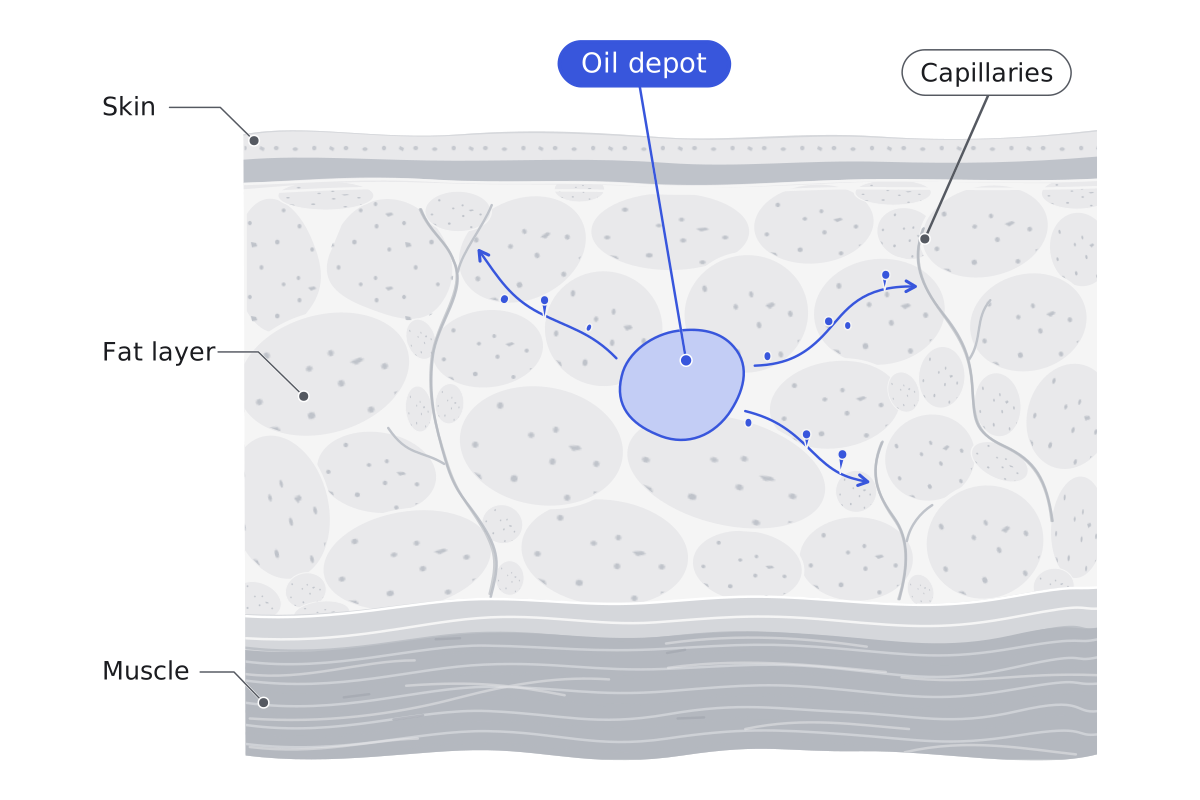
With SubQ, the oil depot sits in the fat under the skin and releases testosterone into small blood vessels.
People use SubQ because the needle is shorter and thinner and the belly is easy to reach. Many also find it hurts less.
This page explains what SubQ is and what the research says. It is not a lesson in how to inject.
If you’re new to it, ask your prescriber’s nurse or a pharmacist to show you in person. Ask them to watch your first shot too.
Is SubQ testosterone FDA-approved?
One product is. Xyosted is a testosterone enanthate auto-injector. That’s a prefilled pen with a built-in needle, approved for shots under the skin.
Its label says to inject it under the skin of the belly only. It also warns against putting it into a muscle.
The cypionate labels are different. The DEPO-Testosterone label says it is “for intramuscular use only,” given deep in the buttock muscle. Azmiro, a newer cypionate product, is also labeled for deep shots into muscle only.
So SubQ isn’t an FDA-approved route for cypionate. That doesn’t make it forbidden. A prescriber can choose to use a medicine outside its labeled route when they judge it right for a patient, and published studies describe SubQ cypionate.
It does mean the choice, and the teaching, belongs with your prescriber.
Does SubQ testosterone work as well as IM?
In the studies so far, it seems to. A 2022 review found that SubQ shots at doses like IM ones gave similar blood levels. It also said the data are limited.
Most studies are small. Many were in transgender men, not men with low testosterone. Here is what each one looked at:
| Study | Who | What it found |
|---|---|---|
| Study from 2006 | 22 men with low testosterone, weekly SubQ enanthate | All reached normal levels; no site reactions reported |
| Study from 2017 | 63 transgender men, weekly SubQ cypionate or enanthate | All reached the normal male range; all 22 who had switched from IM preferred SubQ |
| Second study from 2017 | 11 transgender men, weekly SubQ cypionate | Average levels stayed in range across the week |
| Study from 2018 | 14 transgender men, IM then SubQ | Similar total exposure; less pain with SubQ |
| Study from 2019 | 150 men with low testosterone, weekly SubQ enanthate auto-injector | 92.7% had an average level of 300 to 1,100 ng/dL at week 12 |
What’s missing is a large, randomized trial in men with low testosterone. It would compare SubQ and IM cypionate head to head. Until there is one, “similar” is the fair word, not “better.”
How does SubQ compare with IM testosterone?
| Subcutaneous (SubQ) | Intramuscular (IM) | |
|---|---|---|
| Where the oil goes | Fat under the skin | Muscle, through skin and fat |
| Usual sites | Belly, love handles; sometimes thigh | Side of the hip, upper outer buttock, outer thigh, shoulder |
| Needle in studies | Short and thin, often 25-gauge, 5/8 inch | Longer, to reach the muscle |
| FDA-approved product | Xyosted (enanthate auto-injector, belly) | DEPO-Testosterone, Azmiro and other cypionate or enanthate vials |
| Typical schedule in studies | Weekly or more often | Weekly to every few weeks |
The line between the two is blurrier than it looks. The 2022 review points to imaging studies of IM shots in men. They found that 12% to 85% of those shots actually ended up in fat.
In those cases, the fat over the muscle was thicker than the needle was long. That’s one reason needle length is chosen for each person and each site.
Are testosterone levels steadier with SubQ injections?
They tend to be. Much of that is because SubQ is usually given weekly or more often, not because of the route alone.
In a study of 11 people on weekly SubQ, levels were checked seven times between shots. The average total testosterone was 627 ng/dL. Single results ranged from 205 to 1,410, and one person dipped below range just before the next shot.
Steady on average isn’t steady for everyone.
On weekly Xyosted, levels peaked at a median of about 12 hours after the shot, then slowly fell. The average peak was 790 ng/dL and the average low point was 436 ng/dL. In an earlier trial of the same pen, levels settled by week 6.
The review authors think SubQ may be absorbed more evenly. Blood flow and fluid drainage in muscle change with activity and differ between muscles, while fat depends on them less. That’s reasoning, not proof.
Your schedule also shapes the curve, as covered in the guide to weekly vs twice-weekly injections. How long the drug lasts depends on its half-life, the time it takes the level to fall by half.
Where is SubQ testosterone injected?
Mostly the belly. Xyosted is labeled for the belly only. Studies of SubQ cypionate and enanthate used the belly or the thigh.
The TRTracker app offers four SubQ sites. They are the right and left belly and the right and left love handle, the soft area at the side of the waist.
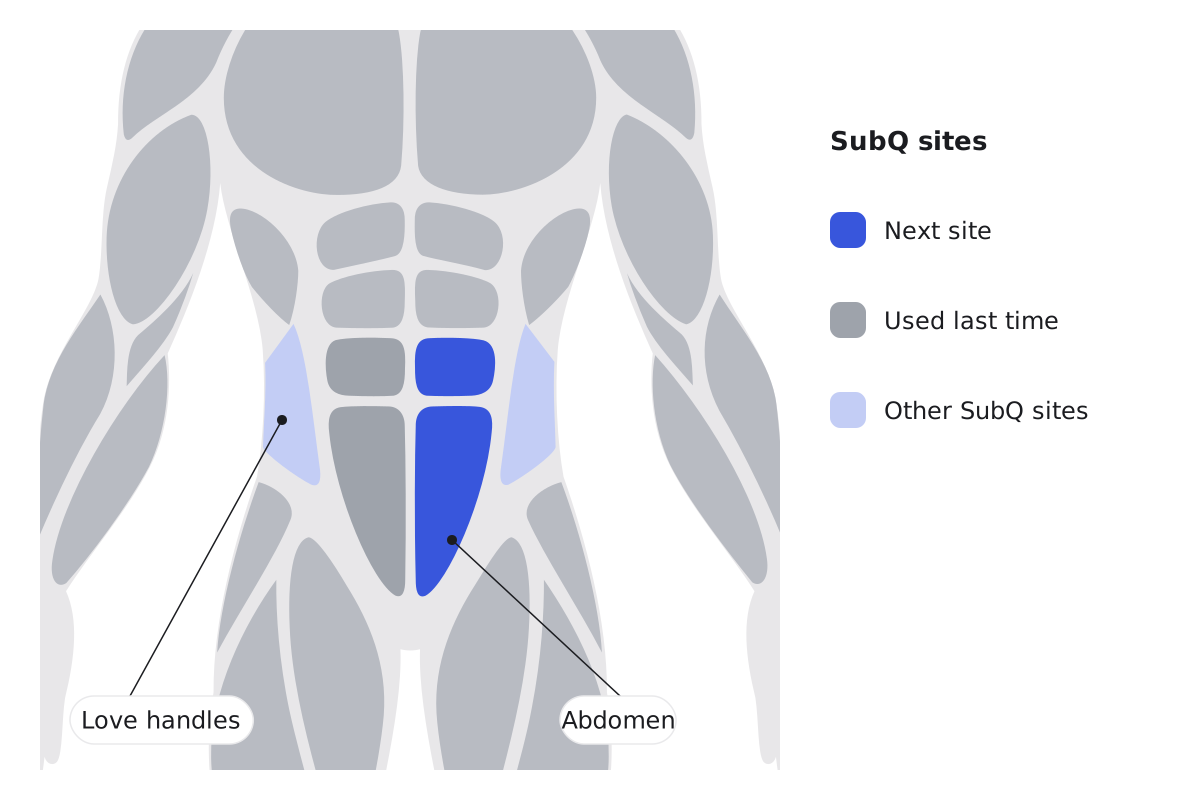
The four SubQ sites on the app’s body map, shown the way the app tracks rotation: next site, used last time, and the rest.
Rotating between sites, and moving a little within each one, gives each patch time to heal. It also helps prevent lumps. Our site rotation planner suggests the next site on this body map.
The full guide to injection sites covers IM and SubQ sites side by side. Your prescriber decides which sites suit you.
What needles and syringes do SubQ studies use?
There’s no single standard, so your prescriber or pharmacist should choose your supplies. Here’s what studies report. These are facts, not a shopping list:
- Syringe: a 1 mL Luer-Lok syringe, which screws onto the needle. The review authors prefer Luer-Lok so the needle can’t pop off while you push thick oil.
- Needle: 20- or 25-gauge, 5/8 inch long, across the studies reviewed. Gauge is the thickness: a higher number is thinner. In the study of 11 people, patients used a 25-gauge, 5/8-inch needle.
- Insulin syringe: the first study in men used a 0.5 mL insulin syringe.
- Auto-injector: Xyosted’s built-in needle was 27-gauge and 5/8 inch in its early trial.
Insulin syringes are marked in units, not mL, which trips people up. Our volume calculator turns the amount on your prescription into mL and units. That way you can check the line.
Our guide to TRT needles covers sizes in more detail. How to pull oil from a vial is in the guide to drawing up an injection. The whole routine is in our guide on how to inject testosterone step by step.
Used needles go straight into an FDA-cleared sharps container.
Does SubQ testosterone hurt less than IM?
For most people in the studies, yes. In the study of 63 transgender men, all 22 who had used IM before preferred SubQ, mildly or strongly. None preferred IM.
In a small study where people tried both, SubQ scored lower for worry before the shot. It also scored lower for pain during and after it. More than 95% of men in the year-long Xyosted trial reported no pain from the shot.
Not everyone agrees, though. One study looked at a different, longer-acting form called testosterone undecanoate. There, 11 of 20 people preferred IM, and SubQ hurt more a day later.
The product, the amount and your own body all matter.
What side effects and site reactions happen with SubQ?
Mild reactions where the shot went in are common and usually short-lived. In Xyosted’s clinical studies, 12.7% of patients had a reaction such as redness, bruising or bleeding. None stopped treatment because of it.
In the study of 63 transgender men, 9 people had minor, short-lived reactions. Four had a small lump that cleared in a day or two.
The 2022 review found no serious site reactions in the published studies. But it said scarring and infection at the site are still concerns. Rotating sites and logging where each shot went are the simplest ways to spot a problem early.
Call your prescriber, or get urgent care, for:
- Redness, warmth or swelling that spreads or gets worse after a day or two, pus, or a fever. These can be signs of infection.
- A hard lump that grows, stays painful or doesn’t go away.
- Trouble breathing, throat swelling, chest tightness or a spreading rash soon after a shot. Get emergency help for these.
Does SubQ change hematocrit, estradiol or blood pressure?
Most data on the SubQ route come from Xyosted, so they can’t be applied to SubQ cypionate. Hematocrit is the share of your blood made up of red blood cells.
On Xyosted, hematocrit rose by an average of 5.4 percentage points after a year. The label tells prescribers to check it about every 3 months. A high hematocrit was the most common side effect in the year-long trial.
One study of 234 men compared weekly IM cypionate with weekly Xyosted. After 12 weeks, Xyosted was linked to lower estradiol (a form of estrogen) and lower hematocrit.
That study wasn’t randomized, and both the drug form and the route differed. So it can’t show that SubQ itself was the reason.
Blood pressure is a warning for all testosterone. Xyosted raised blood pressure by an average of 3.9/1.5 mm Hg after 12 weeks.
In February 2025, the FDA announced label changes for all testosterone products. It removed boxed-warning wording about heart problems and added the results of the TRAVERSE trial. It also added a blood pressure warning where one was missing.
The Xyosted label lists its boxed blood pressure warning as removed in March 2025. Blood pressure now sits in its warnings section. The Azmiro label says to check blood pressure from time to time.
Does SubQ change when your blood should be drawn?
It can. The Xyosted label measures the low point, or trough, 7 days after the last shot. The Endocrine Society tells prescribers to test cypionate and enanthate midway between shots.
The authors of the study of 11 people had another view. They said one test 1 to 5 days after a weekly SubQ shot was enough, because levels were stable on average.
Those are different rules for different products. Ask your prescriber which timing they want. Note the days since your last shot with every total testosterone result.
The details are in trough vs peak testosterone.
What should you ask your prescriber about SubQ testosterone?
- Is my product meant for SubQ or IM use, and would SubQ suit me?
- If we switch, how do I change over, and when do we recheck my labs?
- Which syringe, needle gauge and length should I use?
- Can a nurse or pharmacist show me the first injection and watch me do it?
- Which sites can I use, and what rotation pattern do you suggest?
- Which reactions would you want me to call you about?