

Is twice weekly testosterone better than weekly?
Twice weekly testosterone gives steadier levels than one weekly injection of the same total. The peaks are smaller and the lows are higher. The TRTracker level model and real blood-level studies agree on that.
What hasn’t been shown is that it leads to better results. We found no randomized trial comparing weekly with twice weekly injections.
So the honest answer is “smoother, but not proven better.” Many people do well on weekly injections. Some prefer splitting because they notice a dip late in the week.
Which schedule suits you is your prescriber’s decision. They weigh your symptoms, your labs and how many injections fit your life. This page compares schedules, as one part of your levels on TRT.
What do the label and guidelines say about injection frequency?
Less than you might expect, and not all of it points the same way.
- The DEPO-Testosterone label says cypionate can be given “at intervals of two to four weeks,” because the ester in oil is absorbed slowly. The ester is the fatty chain attached to the testosterone. The label gives a range for prescribers, not a ban on shorter intervals.
- The AUA dosing table lists cypionate and enanthate injections every 7 to 14 days. The AUA is the American Urological Association.
- The Endocrine Society guideline names “peaks and valleys in serum T concentrations that may be associated with fluctuations in symptoms” of injectable cypionate and enanthate as a drawback. It tells prescribers to check levels midway between injections. If the result is outside the target range, they adjust the dose or the frequency.
- The Xyosted label is for one product, an under-the-skin (SubQ) enanthate auto-injector, given once a week into the abdomen.
- The Hikma enanthate label goes the other way for that vial product. It says injections more often than every two weeks are “rarely indicated.”
None of these sources mentions twice weekly by name. Many prescribers use twice weekly and more frequent schedules. They come from clinical practice, not from a label, and one label discourages them.
How much does splitting injections smooth your levels?
The more often the same weekly amount is given, the smaller the swing. The chart at the top of this page shows it for two weeks once levels have settled. The grey curve is one weekly injection, and the blue curve is the same amount in two halves.
The size of the swing depends on which half-life you use. The half-life is the time your body takes to clear half of a dose. Here are two versions of the same model: the app’s 4.5 days, and the label’s 8 days.
| Schedule | Peak to low, app model (4.5-day half-life) | Peak to low, label half-life (8 days) |
|---|---|---|
| Every 2 weeks | About 4.5 to 1 | About 2.3 to 1 |
| Weekly | About 1.7 to 1 | About 1.3 to 1 |
| Twice weekly | About 1.2 to 1 | About 1.1 to 1 |
| Every day | About 1 to 1 | About 1 to 1 |
The ranking never changes: every shorter interval is smoother. The exact numbers do change, and your own body may not match either column.
One real-world check: on weekly Xyosted, the average peak was 790 ng/dL and the average low 436 ng/dL, about 1.8 to 1. You can try your own schedule in the level estimator.
Is every two weeks too far apart?
It’s the oldest schedule and still on the label, but it has the biggest swings. A 2006 review said enanthate given this way lasts two to four weeks, “but produces supraphysiological levels initially and low levels before the next injection.” Supraphysiological means above the normal range.
In the app’s model, the level just before the next injection on an every-two-week schedule is about a fifth of the peak. On a weekly schedule it’s closer to three fifths. That’s why people on longer gaps often feel great early in the cycle and flat near the end.
It’s also why a 2026 review calls every-two-week dosing convenient but not an automatic default.
Every two weeks still works for many people. In the 1980 study below, it kept levels largely in the normal range for most of the interval. Fewer injections also mean fewer sites to rotate and less to remember.
If the end-of-cycle dip bothers you, bring it up with your prescriber.
What does the research show about injection frequency?
There are few direct comparisons, and none of weekly against twice weekly.
- A 1980 study of 23 men with low testosterone. It tested four enanthate schedules: weekly, and every 2, 3 and 4 weeks, with larger amounts for longer gaps. All four kept levels largely in the normal range, and the weekly schedule had the highest average level between injections.
- What the 1980 authors concluded. They judged the every-two and every-three-week schedules the most effective, based on needing fewer injections and on how well they brought LH down to normal. LH is the pituitary signal that tells the testes to make testosterone.
- What wasn’t tested. Twice weekly.
- A 2022 study of 263 men. It compared weekly injections with every-two-week injections of the same total amount over six months. It’s the only direct interval comparison with hematocrit and estradiol results that we found.
- A caution on that study. Its abstract doesn’t say how men ended up on each schedule and reports no random assignment. So differences may reflect who was prescribed what.
- Weekly SubQ studies. In 150 men on weekly SubQ enanthate, the authors described “small peak and trough fluctuations” over a year. In 11 transgender men on weekly SubQ cypionate, levels stayed stable through the week.
A 2026 review for primary-care doctors sums up where things stand. It says every-two-week dosing “should not be the automatic default,” weekly is often reasonable, and more frequent schedules are “optional tools rather than universal standards.” That’s one author’s expert view, not trial evidence.
Does injecting more often lower hematocrit?
Possibly, compared with every two weeks. There’s no data comparing weekly with twice weekly. Hematocrit is the share of your blood made up of red cells, and testosterone raises it.
A review found that short-acting injections like cypionate and enanthate carry a higher risk of high hematocrit than other forms. In one clinic’s records, hematocrit above 50% was seen in 66.7% of men on injections, against 12.8% on gels.
Take the men in the 2022 study who started below 54%. Their hematocrit went above 54% in 1 of 102 men on weekly injections and 4 of 51 on every-two-week injections.
The numbers are small. The authors linked the difference to a higher average testosterone level on the every-two-week schedule, not only to the swing.
A shorter interval doesn’t make hematocrit checks unnecessary. In the weekly SubQ enanthate trial, a raised hematocrit was among the most common side effects.
The Endocrine Society tells prescribers to check it at baseline, at 3 to 6 months and then yearly. More on what the number means is on our hematocrit page.
Does injection frequency change estradiol or how you feel?
The evidence here is the thinnest of all. Estradiol is a form of estrogen your body makes from testosterone.
Forums often say splitting injections keeps it lower. In the one comparison we found, estradiol rises didn’t differ between weekly and every-two-week injections.
We found no study of estradiol on twice weekly injections. Estradiol is one of the labs your prescriber may follow.
How you feel is a fair reason to ask about a schedule. The Endocrine Society links the peaks and valleys of injections to “fluctuations in symptoms.” If you notice the same dip in energy or mood at the same point every cycle, write it down with the days since your injection. That’s useful information for your prescriber, even without a trial behind it.
What do EOD, E3D and daily injections mean?
These are terms you’ll see on forums:
- E3D: every third day.
- EOD: every other day.
- ED: every day.
Each is more frequent than twice weekly. In the app’s model, the curve gets flatter with each step, and a daily schedule is almost flat.
These schedules are usually done with small SubQ injections, which are easier to give often. A review of SubQ testosterone notes it is easier to self-inject and may help people stick with treatment. How SubQ works is covered in SubQ testosterone.
The trade-off is more injections. The 2026 review warns that extra frequency “may add burden without clear benefit” if a weekly schedule already works.
What are the practical trade-offs of more frequent injections?
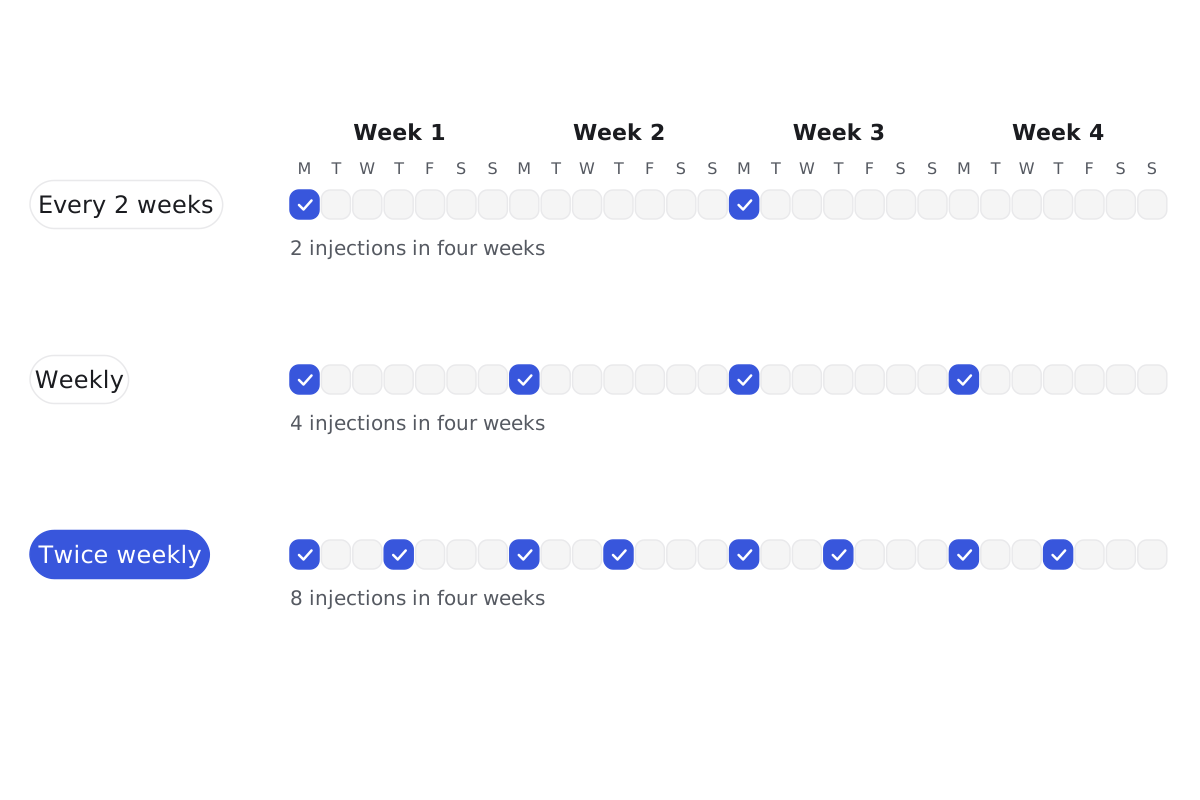
Over four weeks: 2 injections every two weeks, 4 weekly, 8 twice weekly.
- More injections. Twice weekly means about 8 injections a month instead of 4, and twice the needles, syringes and alcohol pads.
- More site rotation. Each injection needs a site that has had time to recover. Note that Xyosted is labelled for the abdomen only.
- Smaller amounts each time. Smaller volumes can be easier to inject, especially under the skin.
- Uneven days. Twice weekly can’t split a week into two equal halves on a calendar. Many people use Monday and Thursday, which means gaps of 3 and 4 days.
- Keeping track. It’s easy to lose count of days and sites. A log of the date, time, site and side of each injection keeps the schedule on track and gives your prescriber exact timing next to each lab result.
- Missed injections. A late injection matters less when each one is smaller, but more injections also mean more chances to forget. Ask your prescriber what to do if you miss one.
How does your schedule change when to get blood drawn?
The schedule moves the days. On weekly injections a midpoint draw is around day 3 or 4. On twice weekly it’s around a day and a half to two days after an injection.
A trough is always taken right before the next injection. It is your lowest level of the cycle. With a flatter curve, the difference between draws gets smaller, but it doesn’t disappear.
The Endocrine Society tells prescribers to measure injectable testosterone midway between injections. The 2026 review asks prescribers to record the timing of the last injection and of the blood test with every result.
You can do the same with your own records. Our guide to trough vs peak testosterone explains how draw timing changes what a result means.
If your schedule changes, results before and after aren’t directly comparable, so note the switch date. Your total testosterone history makes much more sense that way.
What should you ask your prescriber about injection frequency?
- Would a shorter interval make sense for me, and why or why not?
- If we change the schedule, how do I make the switch, and when do we recheck labs?
- Which draw do you want on the new schedule, and how many days after an injection?
- Would SubQ make more frequent injections easier for me?
- Which symptoms would you want me to track before deciding?
Don’t change your schedule or split your injections without your prescriber’s instructions. If you have chest pain, trouble breathing, or pain or swelling in one leg, get emergency help.