

What is the half-life of testosterone cypionate?
The cypionate half life on the label is about eight days. The DEPO-Testosterone label says: “The half-life of testosterone cypionate when injected intramuscularly is approximately eight days.” The newer Azmiro cypionate label repeats the same figure.
A half-life is the time it takes for a level in your blood to fall by half. If a level is 800 at the peak, one half-life later it is about 400, then about 200. The catch is that published numbers for cypionate don’t agree, and the reason shows how the injection works.
This page is one part of how testosterone levels move on TRT. It covers the drug itself: how long it lasts, when it peaks and how long it takes to clear. For when to have blood drawn, ask your prescriber which draw time they want.
Why do you see different half-life numbers for cypionate?
Because the number depends on what you measure, in whom, and how. Here are the main figures side by side.
| Source | Who was studied | Half-life | What it reflects |
|---|---|---|---|
| DEPO-Testosterone and Azmiro labels | Not stated | About 8 days | The official figure after an intramuscular injection |
| 2018 population model | 31 healthy men, weekly injections | 4.05 days | Model that also accounts for the men’s own testosterone |
| 2018 population model, same model without own production | Same men | 6.87 days | Shows how much the method changes the answer |
| Earlier analysis of the same trial (1997) | Same 31 healthy men | 6.9 days (mean) | Standard curve-fitting method that ignores the men’s own production |
| Testosterone itself, free in blood | General | 10 to 100 minutes | The hormone once it is released |
The 2018 study was built to look at steroid misuse. Its 31 healthy men got 100, 250 or 500 mg a week for 14 weeks. Two of the three groups got far more than usual replacement, so they are not typical TRT patients.
The authors think their lower figure is lower because the model counts the men’s own testosterone, which the earlier method ignored.
The TRTracker app and our level calculator use an effective half-life of 4.5 days plus a separate one-day release step. That sits between the study figures and gives an estimate for an average person, with an uncertainty range. It’s not a measurement of you.
If testosterone only lasts minutes, why does cypionate last days?
The labels note that testosterone itself has a half-life of 10 to 100 minutes once it is in the blood. What lasts for days is the injection, not the hormone.
Cypionate is testosterone with an ester attached: a small chemical tail that makes it dissolve in oil. Injected into muscle, the oil forms a small pool called a depot. The DEPO-Testosterone label says esters in oil “are absorbed slowly from the lipid phase,” which is why cypionate can be given weeks apart.
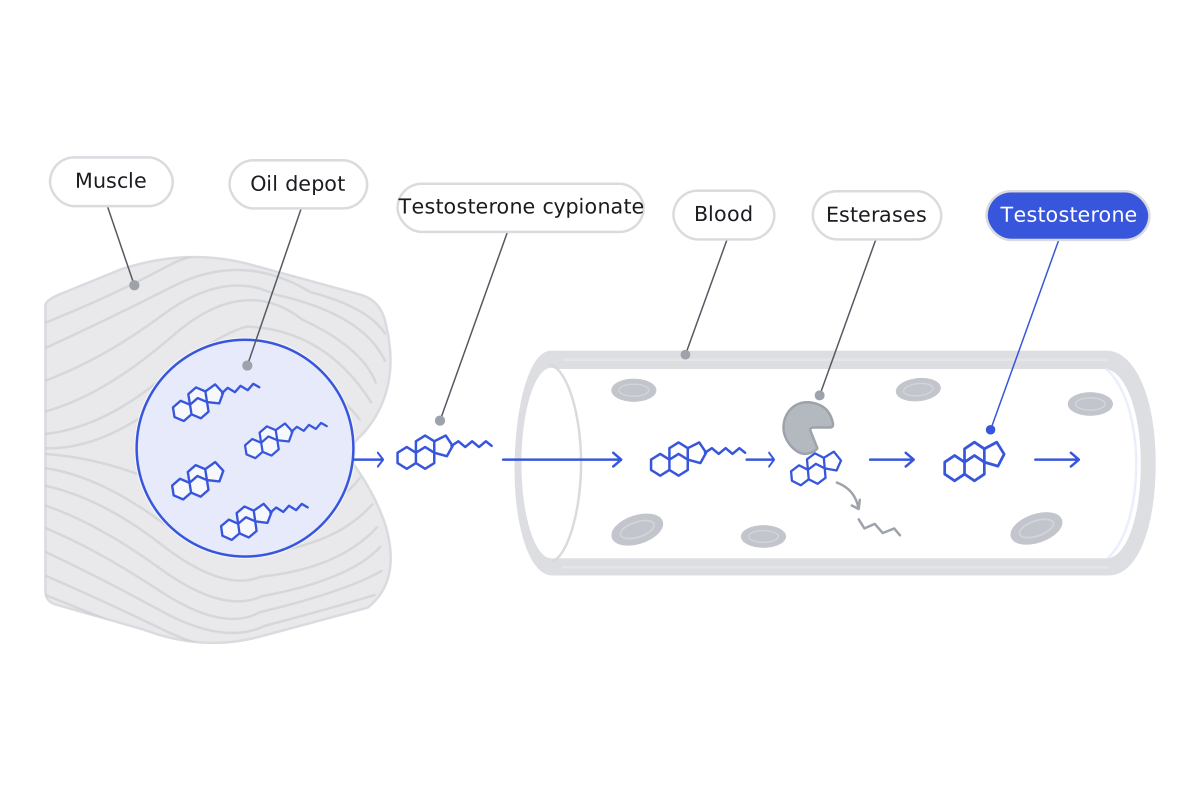
The oil depot releases the ester slowly; enzymes called esterases then cut off the tail, leaving active testosterone. Simplified: some of this happens in tissue before the ester reaches the blood.
The slow step is release from the depot, not removal from the body. So the measured half-life mostly reflects that release. Pharmacologists call this flip-flop kinetics: the tail of the curve shows absorption, not elimination.
The 2018 study’s authors suggest cypionate likely behaves this way, though their own model fit did not prove it. Our reading: the eight-day figure is best seen as how long a dose appears to last in the blood.
When does testosterone cypionate peak after an injection?
Within a few days. In the best-known study, 11 men with low testosterone were followed after 200 mg cypionate injections into muscle. Their total testosterone rose about threefold and peaked on days 2 to 5.
Free testosterone, the part not bound to proteins in the blood, rose faster and peaked on days 2 to 3. A review table lists above-normal levels four to five days after a cypionate injection. The Azmiro label, from a single-injection study in 26 men, gives a median time to peak of about 72 hours, ranging from one to eight days.
That wide range is normal. Your muscle, the injection site, the amount and the oil all change how fast the depot empties.
For SubQ (under the skin) cypionate, no reliable time-to-peak data were found. The only SubQ product with a label, Xyosted, is enanthate, and it peaked a median of about 12 hours after its weekly dose. A different ester in a different setup can’t be transferred to cypionate.
How fast does the level fall after one injection?
The chart at the top of this page shows the TRTracker app’s model for a single injection. In that model the level peaks a little under three days after the injection. It falls to half the peak around day 9, a quarter around day 13 and an eighth around day 18.
The first halving takes longer than the next ones. That is because the depot is still releasing while the body clears what is already there.
Real data match that shape. In the 1987 study, many men were above the normal range between days 2 and 7. Levels were back to their own baseline by days 13 to 14.
The same study found estradiol, a form of estrogen, rose with testosterone. LH, the brain’s signal to the testes, was suppressed after the injection. You can see how this shape changes with different amounts and intervals in the level calculator above.
How does the half-life set the pace of steady state?
Steady state is the point where each injection cycle looks like the last: the same peak and the same low point, week after week. Each new dose lands on top of what is left from the earlier ones, so levels climb for a while before they settle.
A standard rule is that this takes about four to five half-lives. Our arithmetic: about 16 to 20 days at the 2018 figure of 4.05 days, 18 to 23 days at the app’s 4.5 days and 32 to 40 days at the label’s eight days. Our guide to TRT steady state goes further.
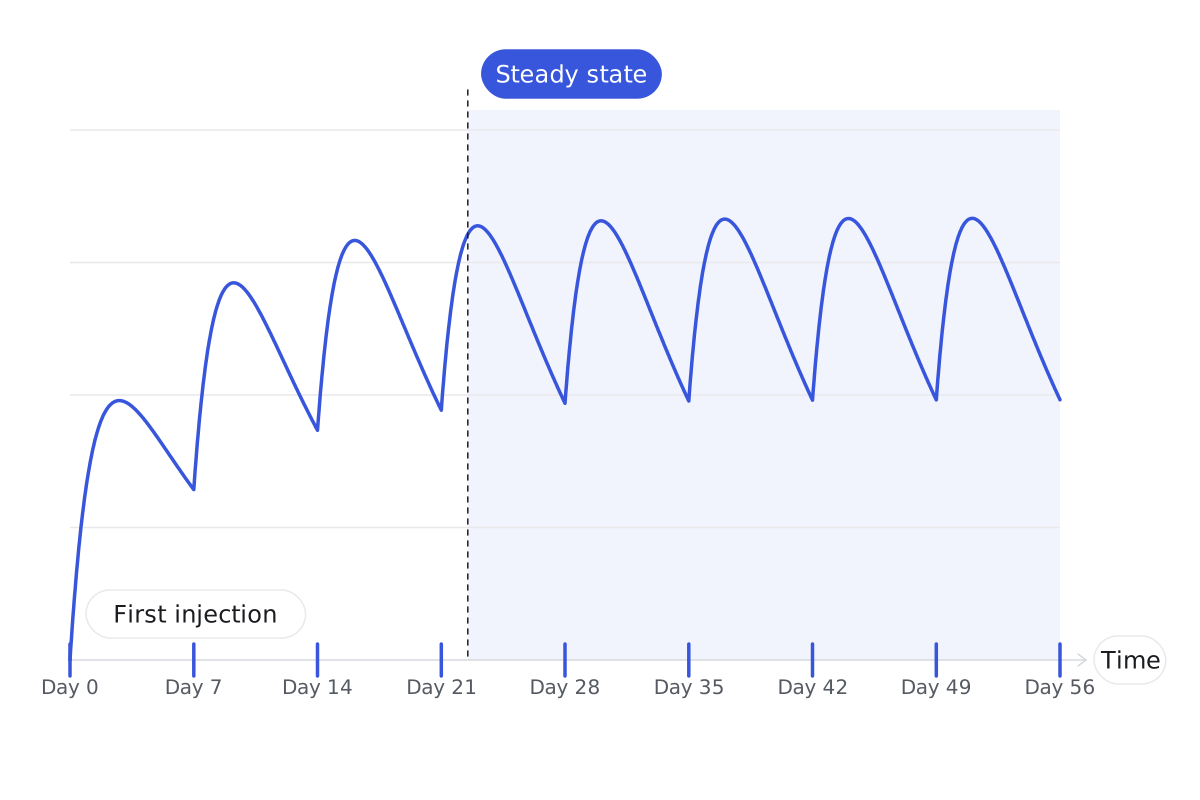
Weekly injections from the first one, from the app’s level model. Shading marks steady state, about five half-lives in.
No study was found that measured time to steady state for cypionate itself. For SubQ enanthate, both the Xyosted label and an earlier trial report steady state by week 6.
That is one reason the Endocrine Society tells prescribers to check levels 3 to 6 months after starting, depending on the formulation.
How long does testosterone cypionate stay in your system?
There are two different questions here: how long the injected testosterone lasts, and how long your own production takes to come back.
The injected dose. After five half-lives, about 97% of a dose has cleared. That’s our arithmetic on the figures above: about 20 days at 4.05 days, 23 days at 4.5 days, and 40 days at eight days.
This page doesn’t cover drug-test detection windows; no primary source gives one for cypionate.
Here is the same arithmetic for each half-life, counted from the peak. It ignores the first few days while the depot is still releasing, so real curves run a little behind it.
| Half-lives after the peak | Share of the peak left | Days at 4.05-day half-life | Days at 4.5-day half-life | Days at 8-day half-life |
|---|---|---|---|---|
| 1 | 50% | About 4 | About 4.5 | About 8 |
| 2 | 25% | About 8 | About 9 | About 16 |
| 3 | 12.5% | About 12 | About 13.5 | About 24 |
| 4 | About 6% | About 16 | About 18 | About 32 |
| 5 | About 3% | About 20 | About 22.5 | About 40 |
Your own testosterone. TRT turns down the signals that tell your testes to make testosterone. In the 2018 study, the men’s own production stayed suppressed after the last injection, then slowly recovered.
The model put its return to baseline at about week 23 of the study in all three dose groups. The 14 weekly injections ran from week 2 to week 15, so that is about eight weeks after the last one. They were healthy men, and two groups got high amounts, so treat it as an illustration, not a prediction for you.
Sperm production recovers more slowly still. A review found many men recover normal sperm production after stopping TRT “if allowed sufficient time,” but some don’t.
If fertility matters to you, talk to your prescriber before starting or stopping. Our guide to TRT and fertility covers this, and LH and FSH blood tests show the signals coming back.
Is cypionate’s half-life different from enanthate’s?
The figures we found are close, but the evidence is thinner than many websites suggest, and we found no reliable head-to-head comparison.
The enanthate label gives no half-life in days, only the 10- to 100-minute figure for testosterone itself. In the comparison group of one trial, 10 men on 200 mg of enanthate into muscle had a mean half-life of about 173 hours, or 7.2 days.
A review table lists above-normal levels 36 to 48 hours after an enanthate injection and four to five days after cypionate. But it sums up separate studies, so that is not a head-to-head test.
Because no head-to-head data are available to us, we don’t claim the two behave identically. The differences that matter for you, such as the oil, vial sizes and cost, are covered in our guide to cypionate vs enanthate.
What does the half-life mean for your blood tests?
It means the same blood test gives a different number depending on the day. A single injection swings from above the normal range to near baseline over about two weeks. So a result without the days since your last injection is hard to read.
Free testosterone rises faster and higher than total after an injection. A free testosterone result taken near the peak looks higher still.
For cypionate and enanthate injections, the Endocrine Society tells prescribers to measure testosterone midway between injections. Whatever draw your prescriber asks for, note the date and time of your last injection with every result. Your total testosterone history is only comparable when you know where in the cycle each draw fell.
Does the half-life decide how often you inject?
It explains why injections are spaced the way they are, but it doesn’t decide your schedule. The DEPO-Testosterone label tells prescribers that cypionate can be given every two to four weeks because of its slow release. Many prescribers use shorter intervals, such as weekly, which keeps the swing between peak and low point smaller.
The interval, the amount and the route are your prescriber’s decisions, based on your labs and how you feel. If you miss an injection or are late, ask them what to do rather than doubling up. The half-life is why a late injection shows up as a lower level for a while.
What should you ask your prescriber about cypionate’s half-life?
- How many days after my injection should my blood be drawn?
- How long before my levels settle on this schedule, and when will we check them?
- If I’m late with an injection, what should I do?
- If I ever want to stop, how long will it take my own testosterone to come back?
- Does fertility affect how we plan my treatment?
Don’t change your schedule or amount based on half-life numbers online. If you have chest pain, trouble breathing, or pain or swelling in one leg, get emergency help.