
What does high hematocrit on TRT mean?
High hematocrit on TRT means red blood cells make up a bigger share of your blood than your lab’s range allows. Testosterone makes the body build more red cells, so some rise is expected. The real question is how far it goes.
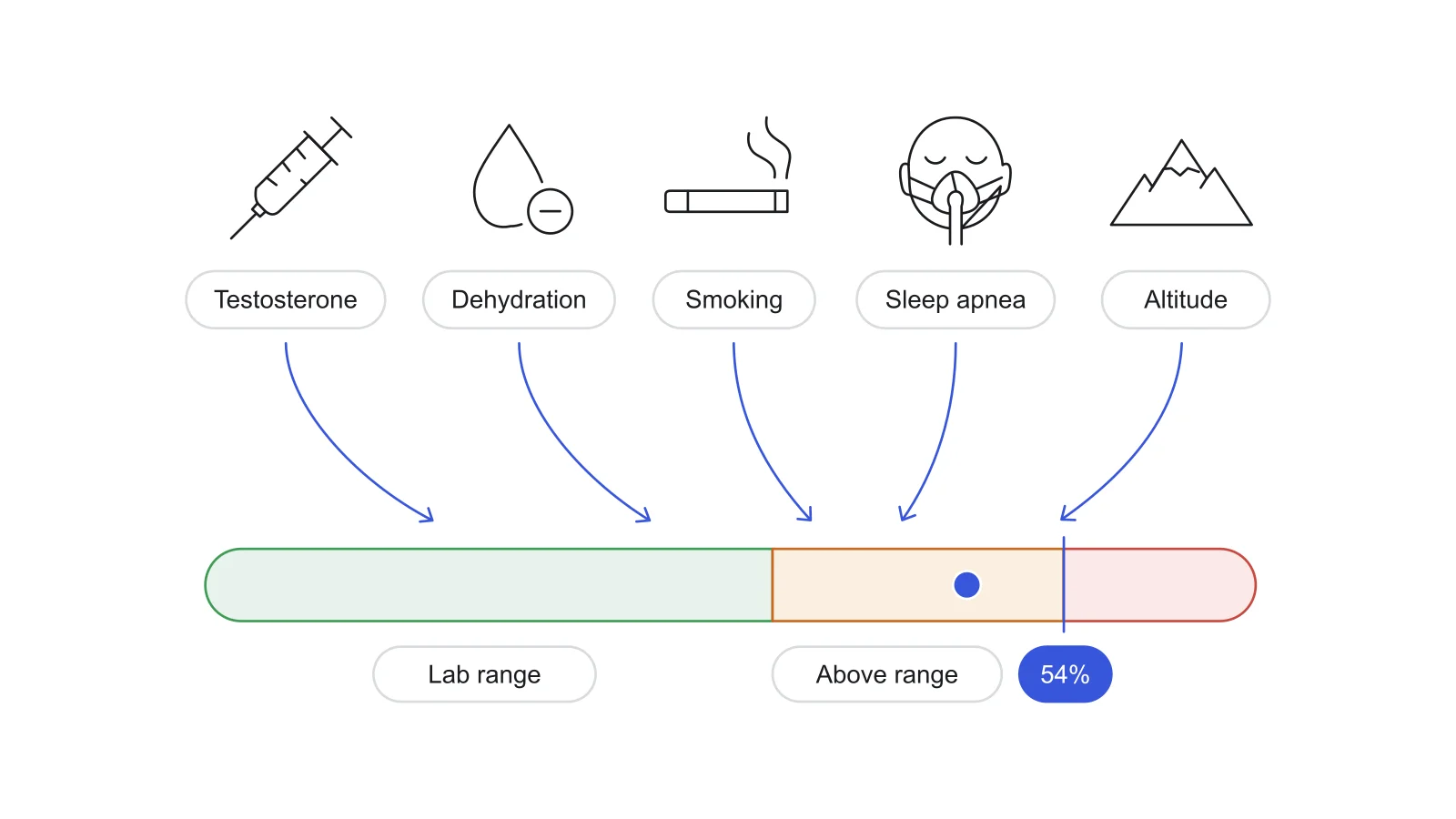
Both the Endocrine Society and the AUA (American Urological Association) name 54% as the point where a prescriber should change the plan. It’s the lab value your prescriber is most likely to bring up, and a main item on the list of what to monitor on TRT.
Everyday things that have nothing to do with testosterone can also move it. That’s why a single high number needs context before anyone acts on it.
What is hematocrit?
Hematocrit is the percentage of your blood volume that is red blood cells. Spin a tube of blood in a machine and the red cells pack down at the bottom. A thin layer of white cells and platelets sits above them, with yellow plasma (the fluid part of blood) on top.
The red layer’s share of the tube is the hematocrit.
It’s part of a complete blood count (CBC), a standard blood panel. It sits next to hemoglobin, the protein inside red cells that carries oxygen. Ranges differ from lab to lab, so use the range printed on your own report.
How is hemoglobin different from hematocrit?
A CBC reports three closely related numbers:
- Hematocrit: the share of blood volume taken up by red cells, as a percentage.
- Hemoglobin: the amount of oxygen-carrying protein in the blood, usually in grams per deciliter (g/dL).
- Red blood cell count: the number of red cells in a set amount of blood.
On testosterone, hemoglobin and hematocrit rise together. In the US hemoglobin is usually given in g/dL. Some labs elsewhere use g/L, so check the unit on your report.
The 54% threshold is a hematocrit number. The Endocrine Society gives its limits for hematocrit only. The AUA lists hemoglobin and hematocrit together as one item, but states its limits as hematocrit.
The label for one testosterone cypionate product says to check both from time to time. Your prescriber reads all three numbers together.
You’ll also see two longer words. In papers on testosterone, erythrocytosis and polycythemia both mean a hemoglobin or hematocrit that is too high. Polycythemia vera is different: it’s a bone marrow disease, and one of the rarer causes doctors look for.
Why does testosterone raise hematocrit?
Testosterone therapy leads the body to make more red blood cells. Reviews describe a few possible ways this happens, and experts still debate it.
One is hepcidin, a hormone that controls how much iron is free to build new cells. In one study that tested several doses, testosterone lowered hepcidin, which lets more iron reach red cell production. Our ferritin guide covers how iron stores are measured.
Another is erythropoietin, the hormone that tells the body to make red cells. One trial in older men found it rose early in treatment and then fell back toward its starting level. Another trial found no clear change.
A review says newer human studies don’t support the old idea that erythropoietin is the main driver. Testosterone acting directly on bone marrow cells has also been suggested.
This is why the label for one cypionate product says to check hemoglobin and hematocrit from time to time in long-term use.
How common is high hematocrit on TRT?
Common enough that every prescriber watches for it. In a 2024 study of 247 men at one clinic, 57% went above 46% hematocrit. 23% went above 50%, and 5% went above 54%.
Those shares are of all 247 men (142, 56 and 12 men). The men were followed for a median of about three years. Most of them (194 of 247) used long-acting testosterone undecanoate shots, so the numbers may differ for other products.
Two things were linked to a higher chance of passing the thresholds. One was a higher body mass index (BMI, a measure of weight for height). The other was a higher hematocrit before treatment started.
How fast does hematocrit rise, and when does it peak?
Slowly, over months. In a review of treatment studies, hematocrit began to rise within about 3 months and peaked at around 9 to 12 months.
In the clinic study, 33 of the 72 men with timing data hit their highest value in the first year. That’s 46% of the men who passed 46% hematocrit, so more than half peaked later.
So an early normal result doesn’t mean it will stay there. Your starting point matters too. A man who goes from 42% to 50% has had a much bigger change than one who starts at 48%, though both now read 50%.
That’s why your result from before treatment is worth keeping. Neither guideline sets a limit on how big a rise is acceptable. The AUA asks for earlier checks when past values call for it.
The TRT timeline guide puts this next to the other changes in the first year.
Does the type of testosterone change how much hematocrit rises?
It seems to. In a small review of 178 men’s records, a hematocrit above 50% was more common with injections (67%) than with pellets (35%) or gels (13%). The injection group was also younger and started with a higher hematocrit.
A review reports the highest rates with short-acting injections. It suggests the product, the dose and how it is absorbed together set the risk. What matters is how long testosterone stays above the normal range.
| Factor | What the evidence suggests |
|---|---|
| Injections vs gels or pellets | High hematocrit more common with injections in one comparison |
| Higher body mass index | Linked to a higher chance of passing 46% and 50% |
| Higher starting hematocrit | Linked to a higher chance of passing 46% |
| Time on treatment | Rise within about 3 months, peak around 9 to 12 months |
Choosing or changing a product, route or schedule is your prescriber’s decision. Our guide to testosterone injection sites explains how injection routes differ.
What hematocrit level is too high on TRT?
The guidelines use two numbers, and your lab adds a third.
| Number | Where it comes from | What it means |
|---|---|---|
| Your lab’s upper limit | The range on your report | A result above it is flagged high; ranges differ between labs |
| Above 48% before starting (50% at high altitude) | Endocrine Society | On its list of reasons not to start testosterone |
| Above 50% before starting | AUA | The AUA wants a starting test to confirm it is under 50%, and holds off on testosterone until a high result is explained |
| Above 54% on treatment (AUA: 54% or higher) | Endocrine Society and AUA | The Endocrine Society says to stop therapy until it falls; the AUA says it calls for action |
The Endocrine Society says therapy should stop if hematocrit goes above 54%, until it falls to a safe level. The man should be checked for causes such as low blood oxygen and sleep apnea. Treatment can then restart with an adjusted plan.
The AUA aims to keep hematocrit below 54%. It asks for checks every 6 to 12 months, or sooner based on earlier values. It says a hematocrit of 54% or higher on treatment calls for action.
Those are instructions for prescribers. They describe what your prescriber may decide, not something to do yourself. If your result is flagged high, call them before your next injection and ask what to do.
Why does a high hematocrit matter?
More red cells make the blood thicker. The worry is that very thick blood could raise the risk of clots, heart attack or stroke. That’s why the guidelines set a threshold, though how much risk a modest rise adds on testosterone is still debated.
The largest safety trial so far, TRAVERSE, enrolled 5,246 men aged 45 to 80. All had low testosterone and heart disease or a high risk of it. Testosterone gel was not worse than a placebo (dummy treatment) for major heart events.
The testosterone group did have more atrial fibrillation (an irregular heartbeat), sudden kidney injury and pulmonary embolism (a clot in the lungs).
What symptoms can high hematocrit cause?
The guidelines act on the blood test number, not on how you feel. That’s why hematocrit is checked with blood tests. The sources for this page don’t give a list of symptoms tied to high hematocrit on testosterone.
So tell your prescriber about any new symptom, such as a headache, rather than guessing the cause.
Get emergency help for chest pain, sudden shortness of breath, signs of a stroke, or a painful, swollen leg. The label for one cypionate product lists heart attack, stroke and blood clots in the veins among reported reactions.
What else can raise hematocrit?
Testosterone isn’t the only thing that moves the number. Several common factors push it up, and some can add together:
- Dehydration. Doctors tell apart a true rise in red cells from a “relative” one. When you’re low on fluid, red cells simply make up a larger share of the sample.
- Smoking. Smoking raises carbon monoxide in the blood and starves tissues of oxygen. This can cause a rise in red cells that usually goes away after quitting.
- Sleep apnea. Long-term low blood oxygen is a common trigger for more red cells, and sleep apnea is one cause. The Endocrine Society names it as something to check when hematocrit is high.
- High altitude. Living high up can raise red cell mass.
- Lung disease and some heart conditions that lower blood oxygen.
- Rare causes, such as polycythemia vera or tumors that make erythropoietin. Your prescriber may test for these if the picture doesn’t fit.
Tell your prescriber about snoring, daytime sleepiness, smoking or a move to a higher city. Each one changes how they read the number.
How often should hematocrit be checked on TRT?
The Endocrine Society checks hematocrit before starting, again at 3 to 6 months, and then once a year. Many prescribers check more often in the first year, after any change, or when the value is close to a threshold.
The AUA says every 6 to 12 months once things are stable. Our TRT lab schedule compares the two and covers how to time each draw.
How quickly does hematocrit change after a treatment change?
Slowly. In healthy people, red blood cells live for about 120 days on average, so the body doesn’t clear extra cells overnight.
Hematocrit took months to climb after starting testosterone. So expect it to take weeks to months to settle after a change too.
That’s why a recheck very soon after a change may not show much. It’s also why your prescriber may space out follow-up tests.
Can you donate blood if your hematocrit is high?
This comes up all the time in TRT forums. Blood donor rules have no special terms for testosterone. So blood centers handle men on testosterone case by case, using their usual rules and a review by their medical director.
Frequent blood donation is also linked to low iron.
Whether donation has any place in your care is your prescriber’s call. Ask before starting any donation schedule to bring hematocrit down. If you already donate, tell them, because it changes how they read your results.
How should you time and prepare for a hematocrit test?
- Drink normally beforehand. Dehydration can raise hematocrit without any real increase in red cells.
- Note the timing after your last injection. Hematocrit changes slowly, but the testosterone result on the same draw doesn’t. Our blood test timing planner works out the draw window from your schedule.
- Mention anything unusual: a recent illness, a long flight, a stay at altitude, very hard training or heavy sweating.
- Compare like with like. If you switch labs, the range may change too.
- Read it with the rest of the panel. Hemoglobin, total testosterone, estradiol and, if you are monitored for it, PSA from the same draw help your prescriber see the whole picture.
What should you ask your prescriber about a high hematocrit?
- Is this a real rise, or could hydration or timing explain it?
- How does it compare with my starting level, and what’s the trend over my last few draws?
- At what level would you want to change something, and what are the options?
- Should I be checked for sleep apnea or other causes?
- When do you want to repeat the test?
How can you track hematocrit over time?
A single result tells you little; the trend tells you a lot. Write down every hematocrit with its date, the lab’s range, and how many days it was after your last injection.
Plotted together, those show whether it’s creeping up, holding steady or settling after a change your prescriber made. The rest of the panel is covered in the TRT blood work guide.