

 Trough testosterone: peak, trough and midpoint tests
 Cypionate half life: how long testosterone cypionate lasts
 Testosterone cypionate vs enanthate: the real differences
 Twice weekly testosterone vs weekly: what the evidence says
 TRT steady state: how long until your levels settle
 Testosterone still low on TRT? What to check first
 Missed testosterone injection: what happens and what to do
 Testosterone gel vs injections: how the two forms compare
 Best TRT app: how the TRT tracking apps compare
How do testosterone levels on TRT rise and fall?
Testosterone levels on TRT with injections are never flat. After a shot, your level climbs for a day to a few days, peaks, then falls until the next one. The Endocrine Society puts it this way: after an injection into muscle, testosterone rises above the normal range, then slowly declines toward the low range by the end of the interval.
The chart at the top of this page shows the shape for weekly injections, from the TRTracker app’s level model. For the first few weeks, each cycle starts a little higher than the last, because each shot lands on what’s left of the earlier ones. After that, the cycles repeat the same pattern.
The shaded band is the model’s uncertainty range. People clear testosterone at different speeds, so your real curve could sit anywhere inside it.
Real blood tests show the same shape. In a 1987 study of 11 men with low testosterone, one cypionate injection raised total testosterone about threefold. The peak came on days 2 to 5, and levels were back to baseline by days 13 to 14.
Other hormones move with it. In the same study, free testosterone, the small unbound share that tissues use, rose about 4.5-fold and peaked earlier, on days 2 to 3.
Estradiol, which the body makes from testosterone, rose about threefold between days 2 and 7. So for any of these hormones, a draw near the peak reads higher than one near the trough.
With injections, testosterone is never flat. A draw near the peak reads higher than one near the trough.
Three things set the shape of your curve:
- The product: mainly the ester (the part attached to testosterone that slows its release) and the oil it’s dissolved in.
- The schedule: how much, and how often.
- Your body: how fast your depot releases and how fast you clear testosterone, which no chart can know in advance.
You can try different schedules in the level calculator, which uses the same model as the app. This page covers each part of the picture in turn.
It’s about levels while you’re on treatment. Reference ranges for men who aren’t on treatment, by age, are on our total testosterone page.
What testosterone level are prescribers aiming for on TRT?
The middle of the normal range, though each source words it differently. None of these is a number for you to aim at yourself. Each is written for prescribers, often for one product or one group of men.
| Source | What it says about levels on treatment |
|---|---|
| Endocrine Society, 2018 | Aim for the “mid-normal range” for healthy young men; no number given |
| AUA, 2018 | Total testosterone in the middle third of the reference range; the text puts this at 450 to 600 ng/dL “for most labs”, with symptom relief |
| Xyosted label | A trough of 350 to 650 ng/dL, 7 days after the weekly dose, generally keeps levels in range all week |
| AndroGel 1.62% label | No dose change when the morning level before that day’s gel is 350 to 750 ng/dL |
| TRAVERSE trial | Gel adjusted to keep levels between 350 and 750 ng/dL in men aged 45 to 80 at high heart risk |
The AUA (American Urological Association) rates its own advice as conditional, with Grade C evidence, the weakest grade. It admits a narrow range is hard to hit, “especially” with injections into muscle.
It also says men whose symptoms have fully gone away don’t need a dose change just because the number is below the target. Its targets are physiological, not above the normal range, and it found no data supporting higher doses for greater benefit.
What’s the difference between peak and trough testosterone?
The trough is your level just before the next injection, when it’s lowest. The peak is the highest point, a day to a few days after the injection.
A midpoint draw falls halfway between. They are the same blood test, taken at different times, and the trough and peak guide goes into detail.
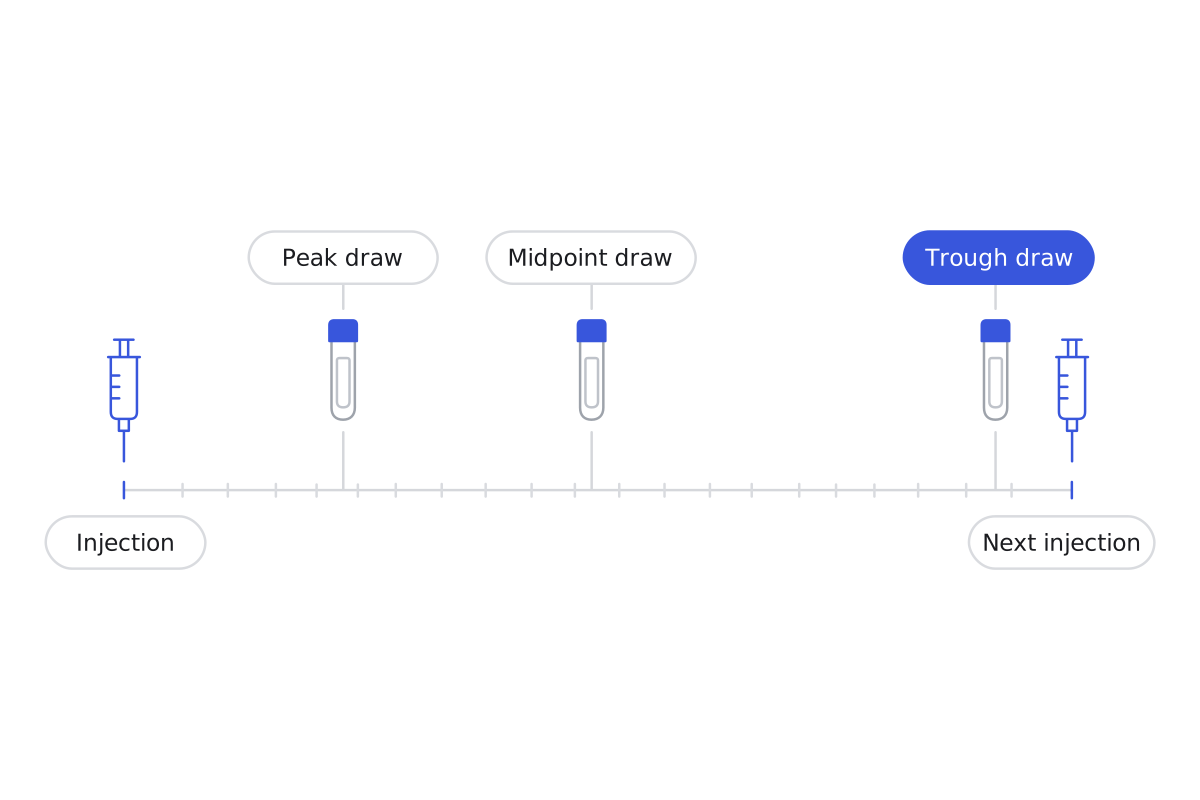
Three draw times within one injection interval. Only the trough sits right before the next injection.
That timing changes the number a lot. In a small study of 10 men on enanthate shots every two weeks, the average peak was about 2,262 ng/dL and the average low point about 466 ng/dL.
On weekly Xyosted the gap was much smaller. The label reports an average peak of 790 and an average low of 436 ng/dL.
The guidelines don’t agree on which draw to use. The Endocrine Society tells prescribers to measure cypionate or enanthate midway between injections. The AUA says no data exist on the best draw time within a cycle, and that a mid-cycle draw can’t show the peak or the trough.
Your prescriber picks the draw. Your part is to note how many days it was since your last injection.
How long does testosterone cypionate last in your body?
The DEPO-Testosterone label gives a half-life of about eight days after a shot into muscle. A half-life is the time it takes for half the drug to clear.
A 2018 model of weekly cypionate in 31 healthy men put it at 4.05 days, once the men’s own testosterone production was accounted for. The cypionate half-life guide explains the gap in detail.
Why so different? Testosterone itself lasts only 10 to 100 minutes in the blood, according to the enanthate label. What lasts for days is the oil depot, the pool of oil in the muscle that releases the ester slowly.
The label says esters in oil “are absorbed slowly from the lipid phase”. The measured half-life mostly reflects that release, and it shifts with the method and the people studied.
The TRTracker app’s model uses an effective half-life of 4.5 days plus a one-day release step. That sits between the published figures. Here is what one injection looks like in that model, next to the same model using the label’s eight days:
| Days after one injection | App model (4.5-day half-life) | Label half-life (8 days) |
|---|---|---|
| Peak | About day 3 | About day 3.5 |
| Day 7 | About 66% of the peak | About 83% of the peak |
| Day 10 | About 42% | About 65% |
| Day 14 | About 23% | About 46% |
| Day 21 | About 8% | About 25% |
The real 1987 data, back to baseline by days 13 to 14, sit closer to the app column. Either way, the half-life is why levels take weeks to settle, and weeks to fall after stopping.
Is cypionate different from enanthate?
Not much on paper. In the US these are the two common injectable esters, and their labels give prescribers the same schedule: every two to four weeks. A switch is the prescriber’s call, and our cypionate vs enanthate guide compares the two labels line by line.
The practical differences are in the vial. Brand cypionate is dissolved in cottonseed oil with benzyl alcohol as a preservative.
Generic enanthate comes in sesame oil with chlorobutanol. That matters if you react to one of the ingredients, because the labels rule out use in people allergic to any of them.
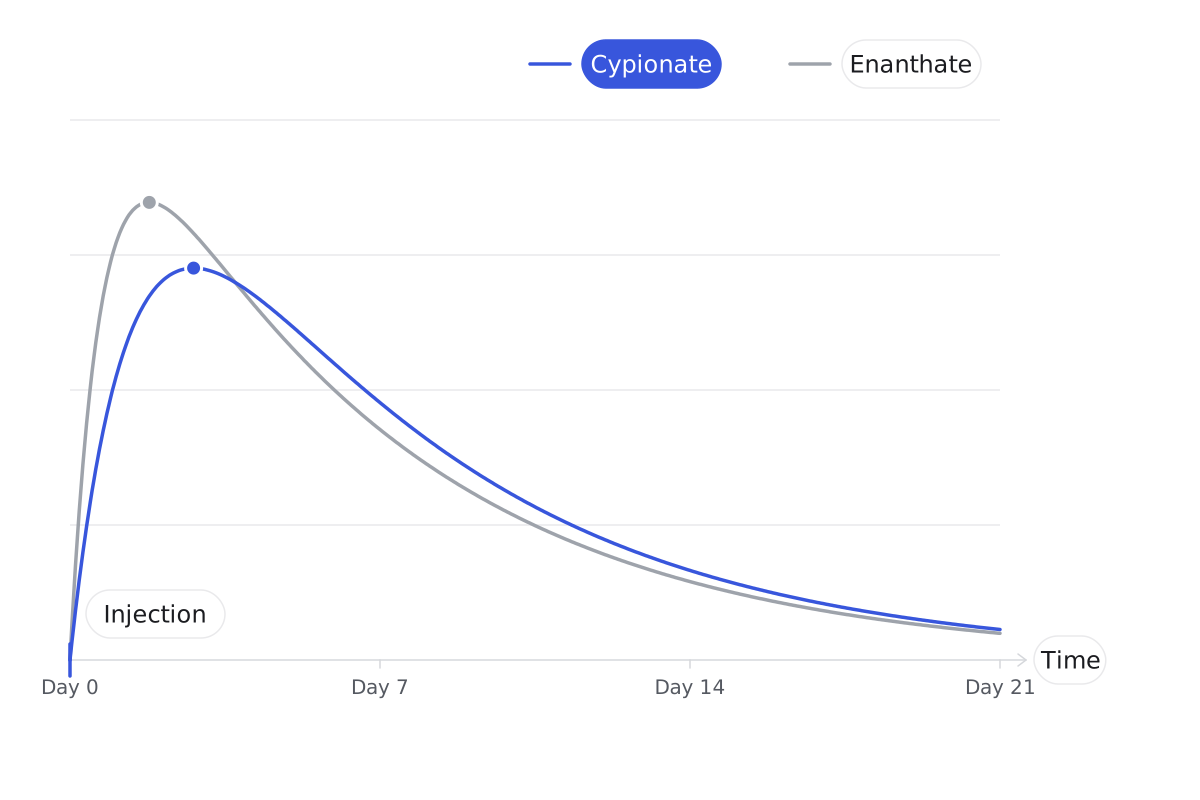
One injection of each ester in the TRTracker model, which gives them the same clearance and a faster release for enanthate. Real differences between people are bigger than the gap between these lines.
How their blood levels compare is less settled than many websites claim. We found no direct head-to-head trial of the two esters, so be careful with claims that one gives steadier or higher levels. The nearest comparison is a 2022 study of 234 men.
It compared weekly cypionate into muscle with weekly enanthate under the skin, at the same weekly amount. Trough levels rose to similar values, but both the ester and the route differed.
Does injecting more often change your levels?
Yes. Splitting the same weekly amount into more injections flattens the curve, with smaller peaks and higher lows.
In the TRTracker level model, the fall from peak to low point is about 78% on an every-two-week schedule, about 41% weekly, about 14% twice weekly and about 1% daily. Our weekly vs twice-weekly guide has the full comparison.
Smoother isn’t proven better. No randomized trial has compared weekly with twice-weekly injections. The closest study looked back at records from 263 men on weekly or every-two-week injections of the same total.
Among men who started below 54%, hematocrit (the share of your blood made of red cells) went above 54% in 1 of 102 men on weekly injections and 4 of 51 on every-two-week injections. Estradiol did not differ significantly.
The AUA tells prescribers that smaller amounts more often are generally preferred, to limit time spent above or below the normal range. More injections also mean more sites to rotate and more supplies. The choice stays with your prescriber.
How long until testosterone levels settle on TRT?
A few weeks. The steady state guide has week-by-week figures from the TRTracker model.
Steady state is the point where each injection cycle looks like the last, with the same peak and the same low, week after week. Until then, each shot lands on top of what’s left from the earlier ones, so levels climb.
A standard rule is four to five half-lives. In the TRTracker model, the weekly average reaches about 85% of its settled level in week 2 and about 95% in week 3.
Using the label’s eight-day half-life instead, four to five half-lives is about 32 to 40 days. For one enanthate product given under the skin, the Xyosted label reports steady state by week 6.
The same arithmetic runs in reverse when treatment stops. The injected testosterone fades over a few weeks. Your own production, switched down by TRT, takes longer to return.
In the 2018 study of healthy men given 100 to 500 mg a week for 14 weeks, the model put the return of their own production to baseline at about eight weeks after the last injection. Stopping should be planned with your prescriber.
That’s why the first check isn’t done in week one. The AUA suggests measuring cypionate or enanthate no earlier than three to four injection cycles in. The Endocrine Society checks at 3 to 6 months, once levels have settled.
The same applies after any change: a new schedule needs time to settle before a result reflects it. No study was found that measured time to steady state for cypionate itself, so these timings are estimates.
Do SubQ injections change your testosterone levels?
Not much, as far as small studies can tell, though they often come with a shorter schedule. SubQ means under the skin, rather than into muscle.
A 2022 study of 234 men found trough levels rose to similar values on weekly cypionate into muscle and weekly SubQ enanthate. In an earlier trial of the same SubQ enanthate device, levels had settled by week 6.
What does differ is the timing of the peak. Xyosted peaked a median of about 12 hours after its weekly SubQ dose, while cypionate into muscle peaks after a few days. That’s one reason the Xyosted label checks levels at trough, 7 days after the dose, rather than midway.
The route is your prescriber’s decision, and the cypionate labels are written for use in muscle. If you switch routes, expect your blood-test timing to change too. Give levels time to settle before the first new result.
Can you feel your testosterone levels change during the week?
Some people can. The Endocrine Society notes that the peaks and valleys of injections “may be associated with fluctuations in symptoms”. The AUA describes large differences between peak and trough that can leave men with symptoms toward the end of the cycle, even when their trough level is still in range.
How you feel has other causes too: sleep, stress, alcohol, illness, a hard week. So a single bad day says little.
A pattern says more. Look for the same dip in energy, mood or sex drive at the same point in every cycle, for several weeks in a row.
If you notice one, write it down with the number of days since your injection. That gives your prescriber something concrete to set against your lab results and your schedule.
A normal number doesn’t rule out a real dip, and a dip doesn’t prove a low number. Your prescriber weighs both.
Why is my testosterone still low on TRT?
There are several common reasons, and most are worth ruling out before anything changes. Our testosterone still low on TRT guide also covers why you may not feel better yet even when the number looks fine.
- Draw timing. A trough draw catches the lowest point of the cycle. A late-cycle result can be expected to read lower than a midpoint one.
- Too early. Levels may not have settled if the test came within the first few weeks or soon after a change.
- Missed or late injections. One late injection lowers the next trough; see the next section.
- Absorption. With gels, the Endocrine Society notes that testosterone levels may vary from one application to the next.
- The lab. Testosterone tests differ between labs and methods, and calibration is a major source of the variation.
- Staying on treatment. In US insurance claims data, only 34.7% of men prescribed a testosterone gel were still filling it at 6 months.
Before your appointment, gather the facts that help: the date and time of your last few injections, any that were late, the date and time of the draw, and which lab did it.
Sometimes the plan itself needs adjusting. The Endocrine Society’s monitoring table tells prescribers to adjust the dose or frequency of cypionate or enanthate when the midway level falls outside the target range.
That’s your prescriber’s call. A 2026 review asks prescribers to record the ester, dose, route, interval, timing of the last injection and timing of the blood test, because “without that context, testosterone results can be misleading”.
What happens to your levels if you miss an injection?
None of the testosterone labels or guidelines we checked says what to do about a missed or late injection. So ask your prescriber or clinic what they want you to do, and don’t double up on your own. The missed injection guide lists what to have ready when you call.
What we can show is what happens to the curve. In the TRTracker model, with weekly injections that have settled, one injection three days late lets the level fall to about 64% of the usual low point before it recovers. Skipping one entirely lets it fall to about 35% of the usual low point by the time the following injection is due.
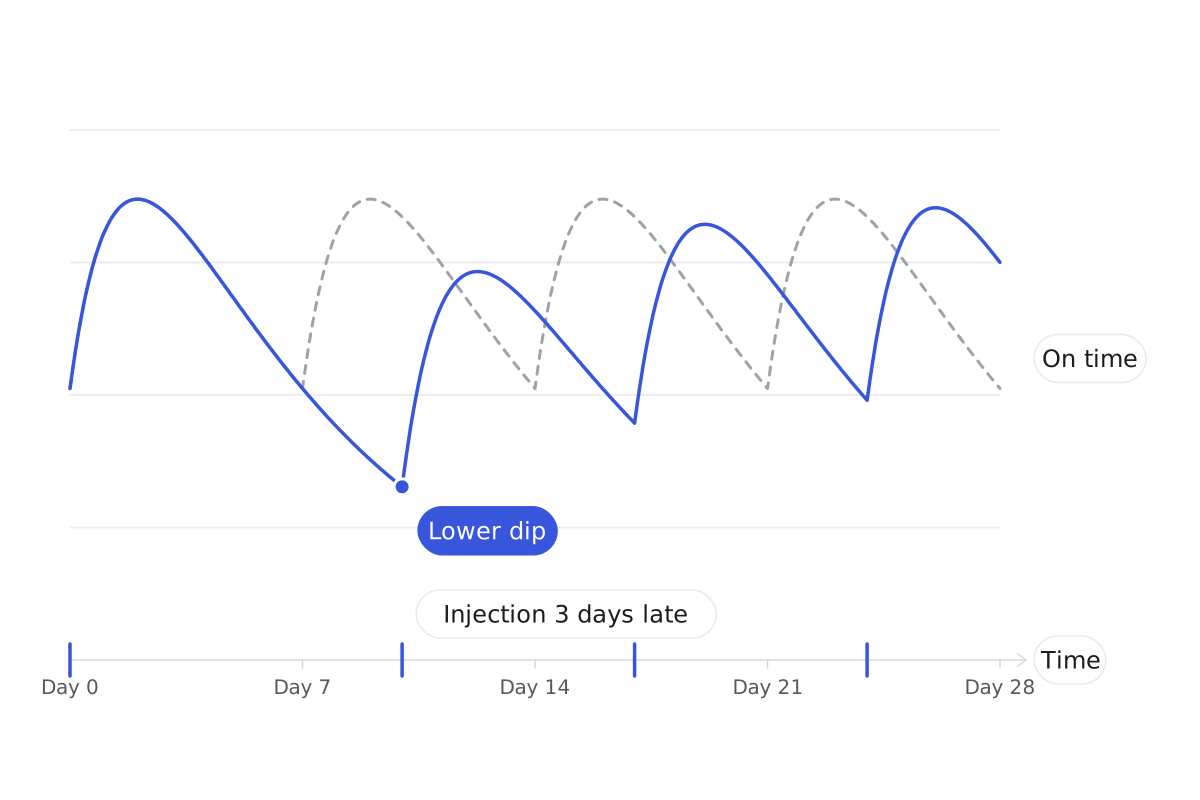
One weekly injection three days late, against the on-time schedule, in the TRTracker model. An illustration, not a prediction for you.
Two caveats. First, the model leaves out your own testosterone production, which TRT usually suppresses.
In the 1987 study, LH, the brain’s signal to the testes, stayed suppressed on regular injections. Second, a blood test drawn after a late injection reflects that late injection, so mention it when you see your prescriber.
How do gels compare with injections for testosterone levels?
Gels are applied every day and absorbed through the skin, so levels don’t swing the way they do with injections. AndroGel 1% reaches steady state by the second or third day.
With AndroGel 1.62%, levels return to about baseline within 48 to 72 hours of the last application. Our gel vs injections guide also covers blood pressure, contact with partners and children, fertility, cost and when to time the blood draw.
The Endocrine Society lists less fluctuation and less erythrocytosis (too many red blood cells) among the gel’s advantages. Among its drawbacks, it lists transfer to a partner or child, and levels that vary from one application to the next.
The gel label carries a boxed warning. Children have shown signs of male hormone exposure after contact with unwashed or unclothed skin where gel was applied.
Injections reach the normal range reliably but spend more time above and below it. In one clinic’s records, hematocrit above 50% was seen in 66.7% of men on injections, against 12.8% on gels.
The injection group was younger and started higher. Timing also differs: gel levels are checked in hours after application, not days after an injection.
How can you see your own testosterone curve?
Your blood test is a single point on a curve you can’t see. What you can see is when your injections happened and when your blood was drawn, and that is most of what it takes to read the result. Our guide to the best TRT tracking apps compares what each app logs, shows and shares, and how they handle privacy.
The TRTracker app logs each injection and draws an estimated curve from it, with an uncertainty range. It’s the same model behind the charts on this page and the level estimator. That makes it easy to see whether a draw landed near a peak or a trough, or after a late injection.
It’s an estimate for an average person, not a measurement. It can’t see your own production, your SHBG (the protein that binds testosterone in your blood), your lab’s method or day-to-day variation.
Whatever you use, a paper notebook or an app, these are the details that make a result readable:
- Each injection: date, time, amount as prescribed, site and side.
- Each blood test: date, time and lab, plus how many days it was since the last injection.
- Changes: the date of any new schedule, product or route.
- How you feel: a short note on energy, sleep, mood and sex drive, with the day of the cycle.
So use the estimate for context and the lab result for decisions. Bring both to your appointments, along with any pattern you’ve noticed in how you feel across the cycle.
What should you ask your prescriber about your testosterone levels?
- Which draw do you want, peak, midpoint or trough, and how many days after my injection?
- What range are you aiming for with my product and schedule, and why?
- How long should I wait after a change before we recheck?
- What should I do if I miss an injection or I’m late?
- Which other labs, such as hematocrit, do you want with my testosterone?
Don’t change your schedule or amount because of one number or one chart. If you have chest pain, trouble breathing, or pain or swelling in one leg, get emergency help.