
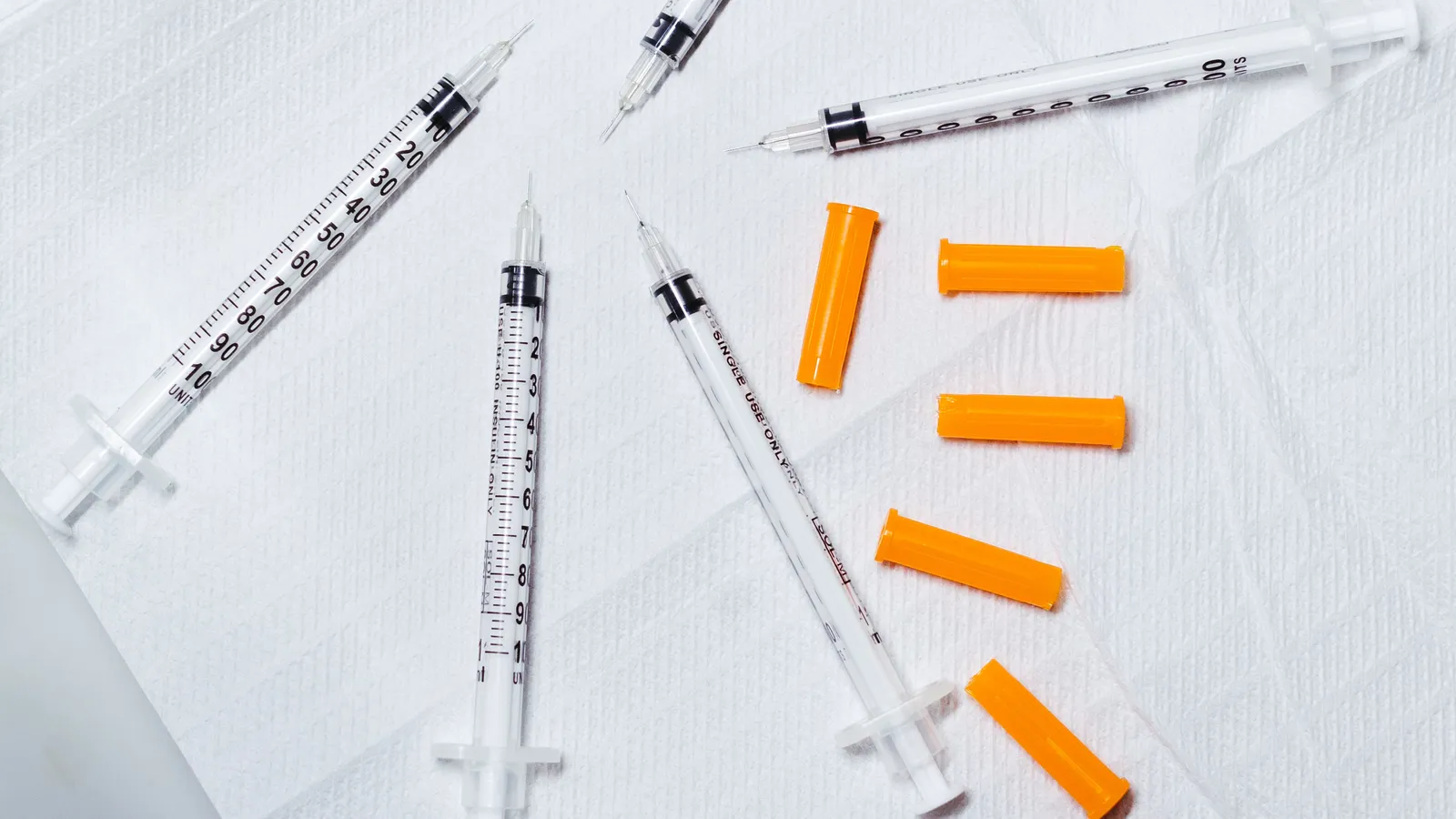
What needle size is used for TRT injections?
There isn’t one standard TRT needle size. The cypionate and enanthate labels don’t name a needle gauge or length. The DEPO-Testosterone label only says cypionate is “for intramuscular use only” and goes deep into the buttock muscle.
So your prescriber or pharmacist picks your needles. They choose them for your product, your route and your body.
What we do know comes from three places. There’s the one label that names a needle, the studies of SubQ testosterone, and scan studies of how deep needles really reach. This page goes through each, so you understand your supplies and know what to ask.
Supplies are one part of injecting at home. The full routine is in our guide to how to inject testosterone. Nothing here replaces being shown in person by a nurse or pharmacist.
What do needle gauge and length mean?
Gauge is how thick the needle is. The higher the gauge number, the thinner the needle. A 32-gauge needle is about as wide as an eyelash.
Length is measured in inches or millimeters, and it decides how deep the needle reaches.
On common BD needles, the color of the hub (the plastic base) tells you the gauge. Pink is 18-gauge, green is 21, turquoise is 23 and blue is 25. Color codes follow an international standard, but makers differ, so check the packet rather than trusting color alone.
Some needles are called thin wall. The outside is the same width, but the inside channel is wider, so thick liquids flow more easily at the same gauge. That matters because testosterone comes in oil, which is thicker than the watery liquids most needle charts are made for.
What needles have testosterone studies used?
These are what studies used, not advice for you. But they show what has been used safely.
| Study | Route and product | Syringe and needle reported |
|---|---|---|
| 2017 study, 11 transgender men | SubQ cypionate, weekly | 1 mL Luer-Lok, 25-gauge, 5/8 inch, abdomen |
| 2017 study, 63 transgender men | SubQ cypionate or enanthate | 1 mL syringe; drawn with 20- or 25-gauge; injected with 25-gauge, 5/8 inch |
| 2006 study, 22 men with low testosterone | SubQ enanthate, weekly | 0.5 mL insulin syringe |
| 2015 Xyosted trial | SubQ enanthate auto-injector | Built-in 27-gauge, 5/8 inch |
| AVEED label, clinic use | IM undecanoate | 18-gauge to draw, then a new needle to inject |
A 2022 review summed up the SubQ studies. Most used 1 mL Luer-Lok syringes with a 20- or 25-gauge, 5/8-inch needle, in the belly or thigh. The review also notes that SubQ shots can use smaller needles than IM (into the muscle) shots.
For IM testosterone, there’s no similar study table. That’s why the length question below matters.
Why does needle length matter for intramuscular injections?
Because the fat over the muscle varies a lot, and a needle that’s too short leaves the oil in fat. A review of CT scans in 100 adults found many had more fat over the buttock muscle than standard needles could get through.
In another study, a small air bubble was injected and then scanned. Only 32% of buttock shots meant for muscle actually reached it.
Body size matters too. An ultrasound study of 119 overweight and obese adults measured the fat over the upper buttock. It averaged 34.5 mm in overweight adults and 51.4 mm in the most obese group.
A 2022 review cites scan estimates that 12% to 85% of IM shots in men really landed in fat.
You’ll see needle lengths quoted from the CDC’s vaccine table. It says most adults need a 1- to 1.5-inch needle for a vaccine in the shoulder, and that clinical judgment should be used. That table is for watery vaccines at one site, not testosterone oil.
It shows why your nurse should choose your needle length for your site and your body.
Which needle is used for SubQ testosterone?
Shorter, thinner ones. The goal is to stop in the fat under the skin, not to reach muscle. The studies above mostly used 25-gauge, 5/8-inch needles, and Xyosted’s built-in needle is 27-gauge, 5/8 inch.
How SubQ compares with IM overall is in our guide to SubQ injections.
Length still matters for SubQ, just the other way round. Research on insulin shots found that needles 8 mm or longer, put straight in, can often reach muscle in the limbs of men and of lean people.
Needles of 4 to 5 mm stayed in the fat.
Those were insulin studies. But they show why one SubQ needle doesn’t suit everyone.
So the same rule applies as for IM. Your nurse or pharmacist picks the needle after looking at your sites, and shows you how to use it.
Do different injection sites need different needles?
Often, yes, because the fat layer differs from site to site. In the CT study above, more people had fat too deep for a standard needle at the upper buttock than at the side of the hip. The CDC’s vaccine advice also ties needle length to the site and to body weight.
If you rotate between sites, ask whether you need more than one needle length. Where each site is, and how rotation works, is in our guide to injection sites.
Which syringe is used for testosterone: Luer-Lok or slip tip, 1 mL or 3 mL?
Tip. Luer-Lok syringes have a threaded tip that the needle screws onto. Slip-tip syringes take a needle pushed straight on.
The SubQ review prefers Luer-Lok. Because the oil is thick, a screw-on needle is less likely to come off during the shot. The clinic-given Azmiro prefilled syringe also uses a Luer lock connector.
Size. A 1 mL syringe has finer markings than a 3 mL one. BD’s 1 mL syringes are marked in hundredths of a mL, and its 3 mL syringes in tenths.
A smaller syringe can make a small amount easier to read correctly. That’s one reason prescribers match the syringe to the amount on your prescription.
Tuberculin syringes are 1 mL syringes marked in mL, often sold with a needle you can take off. Insulin syringes are covered next.
Xyosted users don’t choose any of this. It’s a prefilled auto-injector with the needle built in.
Can you use an insulin syringe for testosterone?
Some prescribers prescribe them for SubQ shots. The first study of SubQ testosterone in men used a 0.5 mL insulin syringe.
They come with a fine needle fixed in place, as thin as 31-gauge and as short as 6 mm. Thick oil moves slowly through a needle that fine.
The bigger issue is the markings, because insulin syringes are marked in units. On a U-100 syringe, 100 units equal 1 mL, so 1 unit is 0.01 mL. Units say nothing about how much testosterone is in that amount of liquid.
The FDA has reported people who mixed up units and mL with another medicine. They drew it from a vial with an insulin syringe and injected five to 20 times the intended amount.
Our volume calculator turns the amount on your prescription into mL and units for your vial’s strength. Check the result with your pharmacist before you rely on it.
An example: reading units on an insulin syringe
James is made up, and his numbers are only an example, not a dose.
James, 47, moves to SubQ shots. His pharmacy gives him U-100 insulin syringes, and his prescription says to inject 0.4 mL.
On a U-100 syringe, 1 unit is 0.01 mL. So 0.4 mL sits at the 40-unit line, not the 4-unit line.
Before his first shot, James asks the pharmacist to point to the right line. He writes “U-100: 40 units = 0.4 mL” on his supply box. If his vial or syringe ever changes, he asks again rather than guessing.
Why use a separate needle to draw up?
People are given two reasons. A wider needle draws thick oil faster, and pushing through a rubber stopper dulls a needle’s point.
AVEED’s is the only testosterone label with written steps for drawing up. It uses an 18-gauge needle to draw, then swaps it for a new needle to inject into the muscle. In the study of 63 transgender men, patients drew up with a 20- or 25-gauge needle and injected with a 25-gauge one.
No testosterone study shows a fresh needle hurts less. So treat this as common practice that your nurse may or may not use. The step-by-step version, including why wide needles can cut tiny bits of rubber from stoppers, is in how to draw testosterone into a syringe.
Can you reuse needles or syringes?
No. The CDC’s rule is “One Needle, One Syringe, Only One Time.” It says a used syringe and needle are both contaminated and must be thrown away. Changing the needle doesn’t help: the CDC counts that as reuse too.
Never share needles, syringes or vials with anyone. Used ones go straight into a sharps container. What to do with it when it’s full is in our guide to sharps disposal.
Do you need a prescription to buy needles and syringes?
It depends on your state. A 2023 survey of state laws found that some states don’t regulate store syringe sales at all.
Others make pharmacies keep syringes behind the counter or set other rules. Each pharmacy can also have stricter rules than the law.
The simplest route is to ask your prescriber to put your syringes and needles on the prescription, with the sizes. Then the pharmacy fills exactly what you were taught with.
Should you check where your syringes were made?
As of the FDA’s last update on August 16, 2024, it was still looking into leaks, breakage and other failures in some plastic syringes made in China. These problems may affect whether a syringe gives the right dose of medicine.
The warning covers syringes used in clinics and at home. It doesn’t cover glass or prefilled syringes. The FDA calls it a changing situation, so check its page for newer advice.
Its advice at that update was:
- Check where the syringe was made on the packaging.
- Use syringes not made in China if you can.
- Keep using what you have if there’s no other choice.
- Report any problems.
If your supplies are affected, your pharmacist can suggest a replacement.
What does a typical injection kit include?
Your prescriber or pharmacist sets the details, but most home kits for a vial include:
- Syringes, usually 1 mL or 3 mL, or insulin syringes for some SubQ plans.
- Needles to draw up, if your plan uses a separate drawing needle.
- Needles to inject, in the length chosen for your sites.
- Alcohol prep pads, for the vial’s stopper and your skin.
- A sharps container.
Keep spares of each, especially before a trip, so a dropped needle never means a late shot. How these fit into each injection day is in our testosterone injection guide.
What should you ask your prescriber or pharmacist about needles and syringes?
- Which syringe should I use, and is it marked in mL or units?
- What gauge and length of needle for drawing up, and for injecting at each of my sites?
- Can you include the syringes and needles on my prescription?
- Where were these syringes made?
- Can a nurse show me how to use them and watch my first injection?