
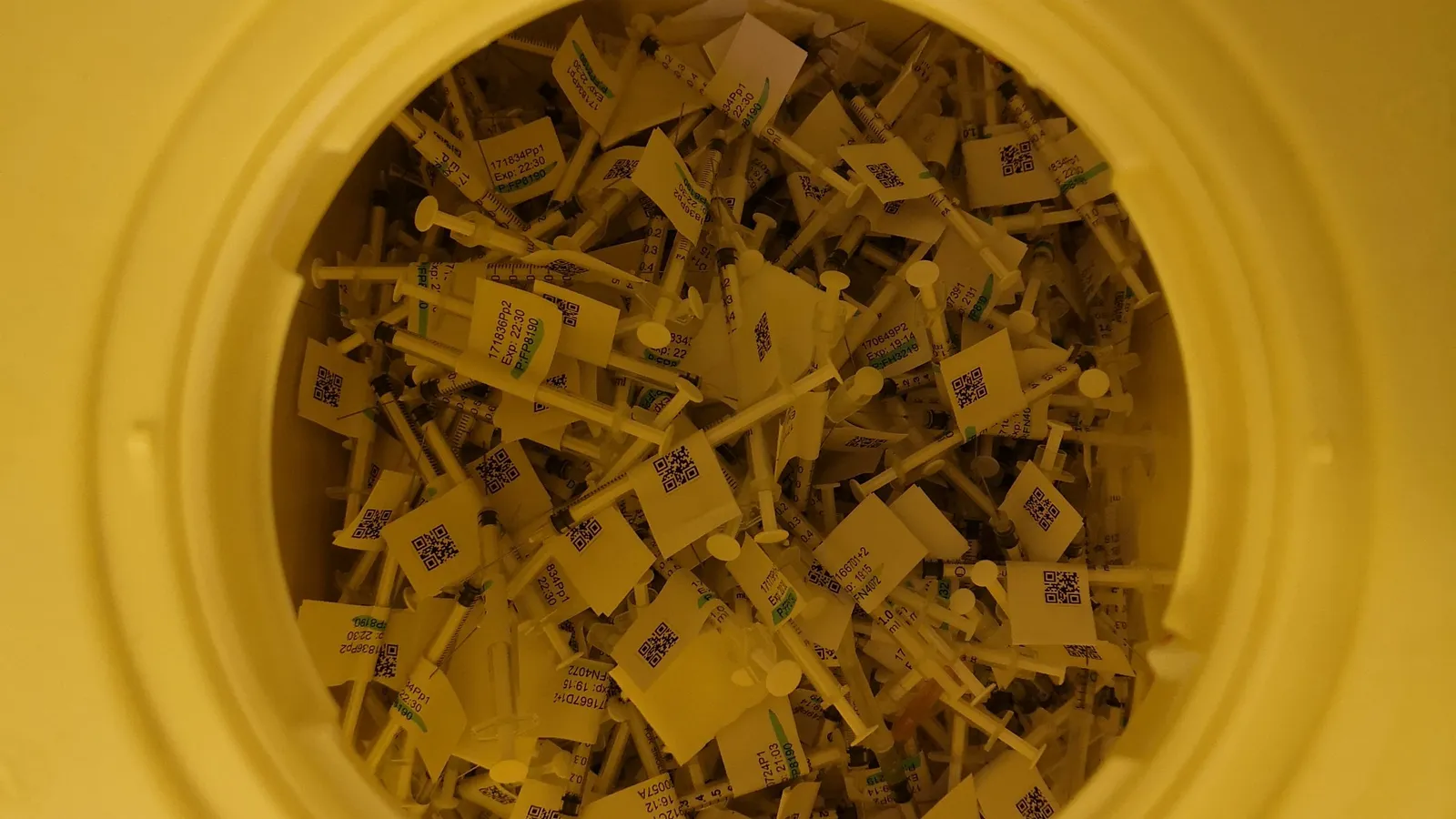
How do you dispose of needles at home?
Here is how to dispose of needles at home, in two steps:
- Put every used needle and syringe into a sharps container right away. The FDA says to do it straight after use.
- When the container is full, get rid of it the way your local rules say.
That second step is where most questions come up, because the rules depend on where you live. This page covers what counts as a container, when it’s full and where it goes. It also covers state rules, what to do after a needlestick and what to do with leftover testosterone.
Disposal is the last step of every injection. The rest of the routine is in our guide to how to inject testosterone.
Why can’t used needles go in the trash?
Because they hurt other people. The FDA says used needles can injure people and spread serious infections, such as hepatitis B, hepatitis C and HIV. The people at risk include trash and sewage workers, janitors, housekeepers, family members and children.
The EPA explains how it happens. Containers can break open inside garbage trucks, or needles end up in recycling by mistake, where people sort waste by hand.
So the FDA’s rule has no exceptions. Never put loose needles in household or public trash cans or recycling bins, and never flush them down the toilet.
What counts as a sharps container?
The best choice is an FDA-cleared sharps container. The FDA describes them as made of plastic that needles can’t poke through, with sides and a bottom that don’t leak and a tight lid that needles can’t pierce. They have a fill line and come in several sizes, including small travel ones.
You can buy them from pharmacies, medical supply companies, healthcare providers and online.
If you don’t have one, the FDA notes that a heavy-duty plastic household container can stand in, such as a plastic laundry detergent bottle. Whatever you use should be:
- made of heavy-duty plastic;
- closed with a tight lid that needles can’t poke through or fall out of;
- upright and stable;
- leak-resistant;
- labeled to warn that hazardous waste is inside.
Avoid clear milk or water jugs. Safe Needle Disposal, an information site on needle disposal, says they usually aren’t strong enough to stop needles.
The FDA also suggests asking your insurer whether it covers containers. You can ask the maker of your medicine whether it gives one away free. Keep the container out of reach of children and pets.
When is a sharps container full?
At about three-quarters. The FDA says that when a container is about three-quarters (3/4) full, follow your local rules for getting rid of it. It also says never to reuse a sharps container.
The reason is safety, not tidiness. The FDA explains that overfilling a container makes a needlestick more likely. FDA-cleared containers have a line that shows when to stop.
When it reaches the line, close the lid firmly, and lock it if your container locks. Then start a new one. If you use a household bottle, tape the cap shut and write a warning on it, such as “Sharps: do not recycle.”
Where do you take a full sharps container?
It depends on what’s available where you live. The FDA says the rules and programs vary by area, and suggests checking with your local trash service or health department. Its main options are:
- Drop-off collection sites, such as doctors’ offices, hospitals, pharmacies, health departments, medical waste sites and police or fire stations. These are free or charge a small fee.
- Household hazardous waste sites run by your community.
- Mail-back programs for certain FDA-cleared containers, usually for a fee.
- Home special-waste pick-up, usually for a fee, often with its own container rules.
Call before you go. Safe Needle Disposal notes that healthcare sites and fire stations usually can’t take full sharps containers, unless a law says they must.
Some retail pharmacies sell mail-back kits with a container and a prepaid label. The EPA also lists syringe exchange programs, which take used needles and get rid of them safely.
Do sharps disposal rules depend on your state?
Yes, a lot. The EPA says medical waste is mostly regulated by state environment and health departments, and that state programs differ a great deal. Here are a few examples from Safe Needle Disposal’s state pages, checked October 21, 2026:
| State | What its page says about home sharps |
|---|---|
| California | Take sealed containers to a drop-off site or use mail-back; never in the trash, loose or in a container |
| Massachusetts | Take sealed containers to a drop-off site or use mail-back; never in the trash |
| New York | A sealed plastic container may go in household trash; hospitals and nursing homes must accept home sharps |
| Texas, Florida, Ohio | A sealed plastic container may go in household trash, never recycling |
Even where a sealed container can go in the trash, loose needles never can. For your own state, use Safe Needle Disposal’s state pages or ask your local health department. The Xyosted instructions say the same: there may be state or local laws about how to throw away used needles and syringes.
What about unused syringes and needles?
Treat unused supplies that have expired, or that you no longer need, like used ones. Safe Needle Disposal says expired, unused sharps can be thrown away as if they were used, following your state’s rules. Donation programs exist, but they usually take only items that are unexpired and still in their original packaging.
Don’t hand spare needles or syringes to friends. Your prescriber and pharmacist chose them for your product and your shots. The CDC’s injection-safety rule is “One Needle, One Syringe, Only One Time.”
Does sharps disposal cost money?
Sometimes. The FDA says drop-off sites may be free or charge a small fee, while mail-back programs and home pick-up services usually cost money. Household hazardous waste days run by your town are often the cheapest choice.
To keep costs down, ask your insurer whether it covers containers. Ask your pharmacy or the maker of your medicine whether it offers a free container or mail-back kit. A larger container also means fewer trips.
Should you recap, bend or clip needles?
Mostly, don’t. The FDA says not to try to remove, bend, break or recap needles used by another person, because it can cause needlesticks and serious infections. Workplace safety law says the same for healthcare staff.
The FDA also warns not to take a needle off without a needle clipper. A loose needle could fall, fly off or get lost and hurt someone.
The simplest habit is to keep the sharps container where you inject and drop the used needle straight in. If you ever have to recap before you can reach one, ask your nurse to show you a safe way.
Needle clippers are sold for home use. Where state rules allow, a clipped syringe may go in the trash. But the clipper itself must be thrown away by state or local rules when it’s full.
What should you do after a needlestick?
Act right away. The FDA’s first aid is to wash the area at once with soap and water, or use a skin cleaner such as rubbing alcohol or hand sanitizer. Then get medical help straight away by calling your doctor or local hospital.
Do the same if blood gets in your eyes, nose or mouth.
A stick from your own used needle carries different risks from a stranger’s. Call anyway, and say whose needle it was.
What about needles found in public places? The CDC’s 2025 HIV guidance says preventive HIV medicine usually isn’t needed after an injury from a thrown-away needle in the community. It says no confirmed cases of HIV caught this way have been reported, and each person’s risk still needs to be checked.
Children get hurt by thrown-away needles too. A 19-year review looked at 274 children treated in Montreal after needlesticks from needles found in the community. None got HIV, hepatitis B or hepatitis C, and about two thirds had picked the needle up on purpose.
That’s the best reason to use a closed container, kept out of reach.
How do you dispose of auto-injectors and leftover testosterone?
Auto-injectors (pens that give the shot for you) are sharps too. The FDA lists them alongside needles and syringes. Xyosted’s instructions say to put the used auto-injector and its cap in an FDA-cleared sharps container right after use, and never in household trash.
Leftover testosterone is handled separately from needles. Its label calls it a Schedule III controlled substance, meaning federal law limits how it’s handled, so never give it to someone else.
The FDA’s first choice for most unused medicine is a drug take-back site or a prepaid mail-back envelope. Because testosterone is controlled, ask the site whether it takes it. Testosterone isn’t on the FDA’s flush list, so it doesn’t go down the toilet or drain.
Not every pharmacy has a take-back kiosk, and whether a site takes a part-used vial varies, so ask first. Our guide to storing testosterone covers expired vials and when to throw an opened one away.
How do you dispose of needles when you’re away from home?
Carry a small travel sharps container. The FDA says to always carry one in case there’s no other option. The EPA’s home-disposal leaflet adds: never put used needles in the trash in hotel rooms, on airplanes or in public restrooms.
Bring the container home and get rid of it with your usual one. Airport rules for used syringes are covered in traveling with testosterone.
What does a simple disposal routine look like?
Put together, the FDA’s advice comes down to a few habits. They sit alongside the rest of your injection routine:
- Keep the container where you inject, so the used needle goes straight in.
- Keep it closed and out of reach of children and pets between uses.
- Watch the fill line and close it at about three-quarters full.
- Know your local option before it’s full: drop-off, hazardous waste site, mail-back or pick-up.
- Have a spare container ready so you’re never tempted to overfill.
Two examples: same routine, different states
These two men are made up, but their choices follow the state rules in the table above.
Dave, 58, in Texas. He injects once a week, with one needle to draw and one to inject. That’s two needles and one syringe every week, or about 100 needles a year. Each one goes straight into a sharps container on the bathroom shelf.
When it reaches the fill line, he closes it firmly and tapes the lid. Texas allows a sealed plastic container in household trash, so it goes in his regular trash bin. It never goes in recycling.
Tom, 49, in California. He uses the same supplies and the same habits at home. The difference comes when his container is full. California doesn’t allow sharps in the trash at all, even sealed.
So Tom asks his pharmacy about drop-off. He keeps a spare container ready, and takes the full one in on his next refill visit. If his pharmacy didn’t take them, a mail-back kit would be his backup.
Rules can change, so check your state’s page or ask your pharmacist before your first container fills up.
What should you ask your pharmacist about sharps disposal?
- Do you sell FDA-cleared sharps containers or mail-back kits?
- Is there a sharps drop-off or drug take-back site near me?
- Does my insurance cover sharps containers?
- What do my state’s rules say about sealed containers in the trash?
- Which syringes and needles am I using, so I know what goes in the container? Our guide to TRT needles explains the types.
Keeping a record of each injection, and which site you used, is part of the same routine. The site rotation planner helps with the site part.