
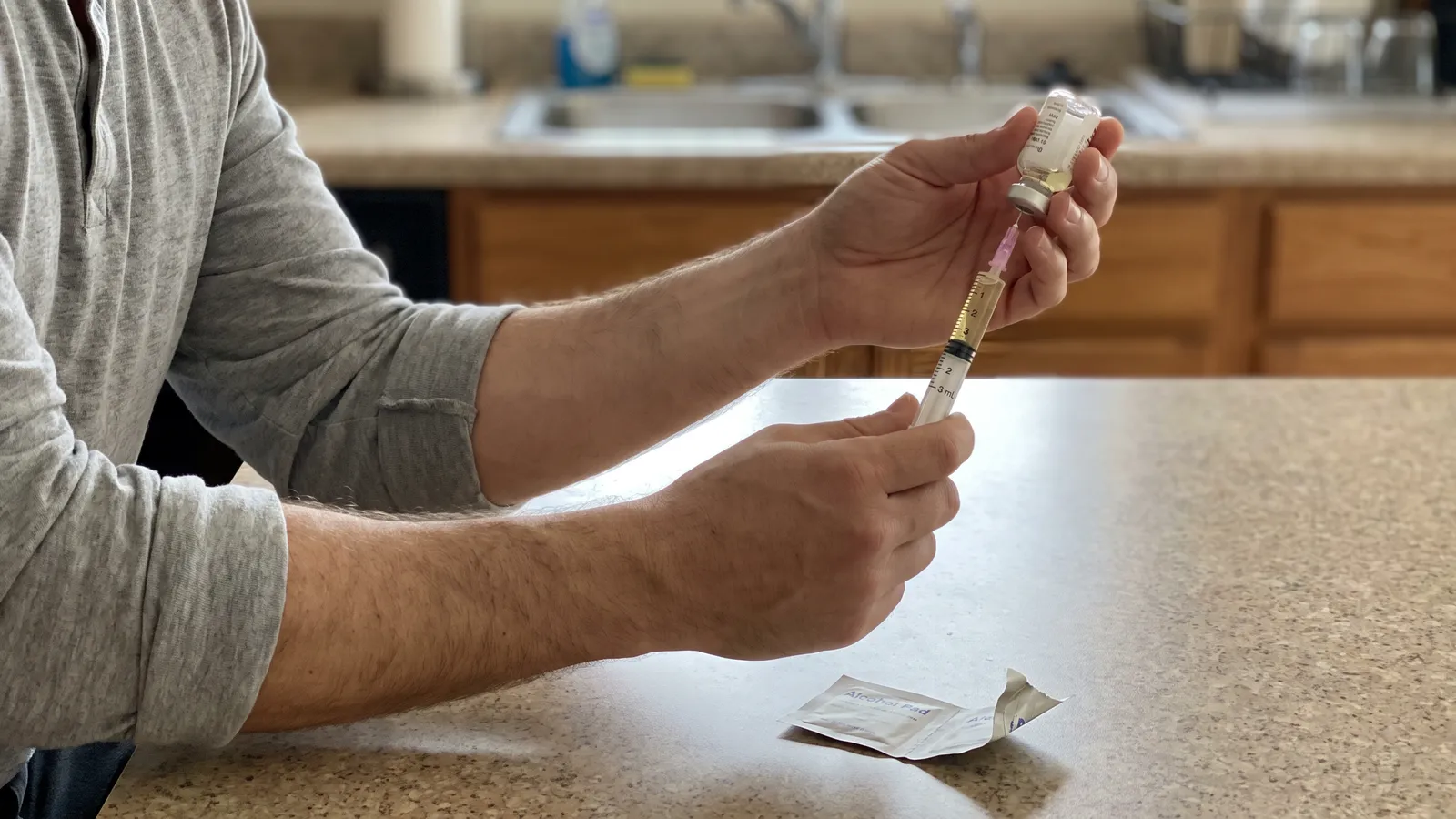
How do you draw testosterone into a syringe?
Here is how to draw testosterone into a syringe in short. Clean the vial’s rubber stopper, push in air, and turn the vial upside down. Slowly draw the oil to the line, remove air bubbles, and switch to a fresh needle before you inject.
The amount always comes from your prescription. This page never tells you how much to draw.
Each step below is tied to a drug label or to CDC injection-safety advice where one exists. Where a step is common teaching with no written source, we say so.
Reading isn’t the same as being shown. Before your first time, ask a nurse or pharmacist to walk you through it in person and watch you do it.
This page covers drawing up only. Our step-by-step guide to injecting testosterone covers the whole routine. Where to inject is in the guide to testosterone injection sites, and shots under the skin are in SubQ testosterone.
What supplies do you need to draw up testosterone?
Your pharmacy or prescriber decides the exact supplies. A typical set for a vial includes:
- The vial. Cypionate comes in cottonseed oil and enanthate in sesame oil, each with a preservative. Check the strength on the label, such as 100 or 200 mg per mL. It decides how much oil your prescription works out to.
- A syringe. Often a 1 mL or 3 mL syringe marked in mL, or an insulin syringe marked in units. Know which one you have.
- A drawing needle and an injection needle. Many kits use a wider needle to draw and a thinner one to inject. The cypionate and enanthate labels don’t name sizes. Our guide to needles and syringes for TRT covers that question.
- Alcohol prep pads, for the stopper.
- A sharps container, the hard plastic box for used needles.
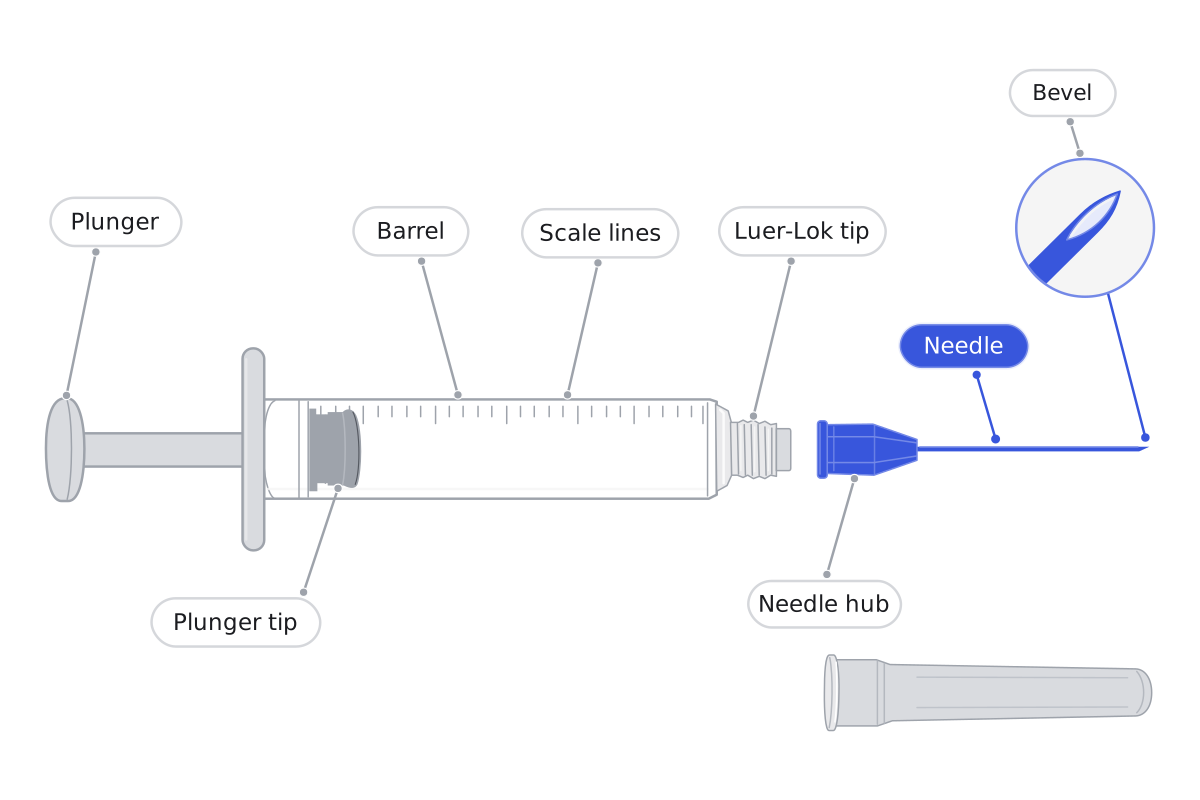
The parts of a syringe and needle. A Luer-Lok tip screws the needle on so it can’t slip off.
A few terms you’ll hear. The barrel holds the oil, and the scale lines on it show the volume. The plunger tip is the rubber end you line up with the scale.
The bevel is the slanted point of the needle. Gauge is a needle’s thickness: a higher number means a thinner needle.
How do you draw testosterone from a vial, step by step?
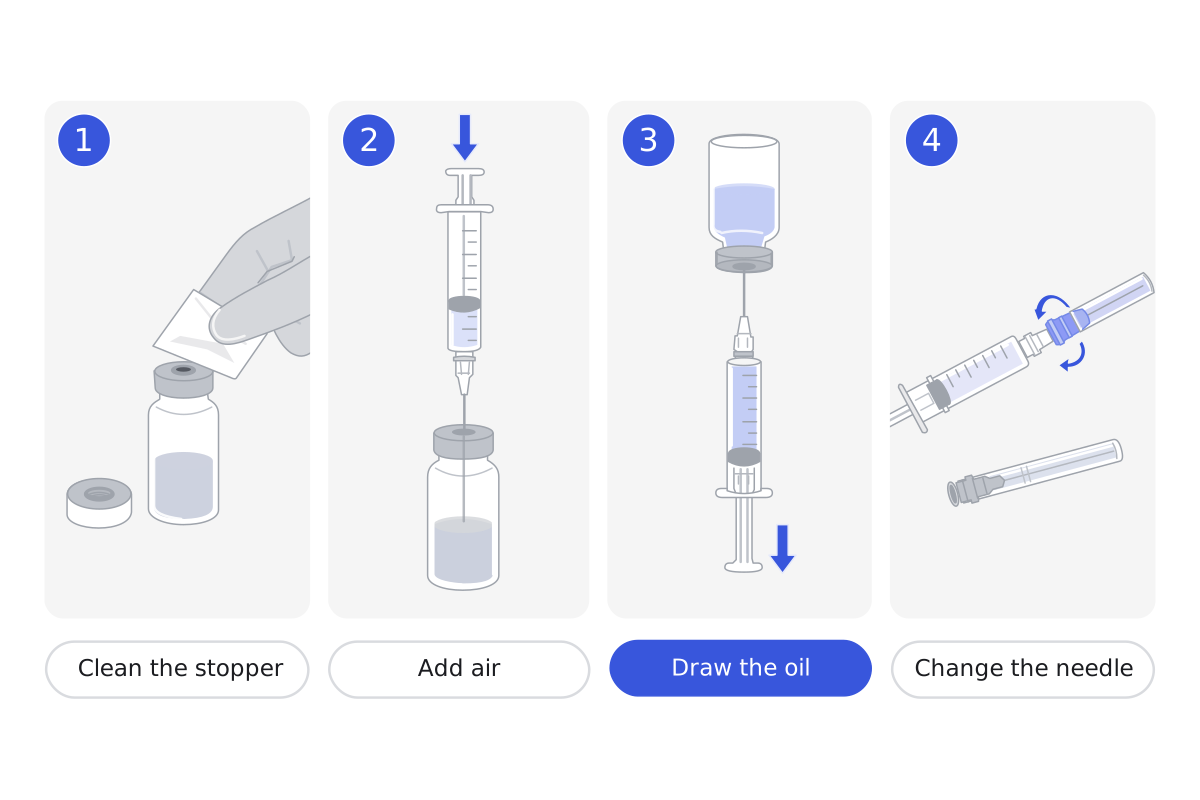
The four core steps: clean the stopper, add air, draw the oil, change the needle.
- Wash your hands and work on a clean, dry surface.
- Check the vial. Read the name, the strength and the expiry date. For an opened vial, also check the date you first used it. Look at the oil: it should be clear, with no specks. Labels ask you to look for specks and color changes before use.
- Clean the stopper. On a new vial, flip off the plastic cap and leave the metal ring in place. Wipe the rubber stopper with an alcohol pad and let it dry. CDC advice is to wipe the stopper with alcohol before the needle goes in.
- Attach the drawing needle to a new syringe and take off the needle cap.
- Pull in air. Draw the plunger back to fill the syringe with air. Use the same amount of air as the oil you’ll take out, as set by your prescription.
- Push the air into the vial. With the vial upright, push the needle through the middle of the stopper and press the air in.
- Turn the vial upside down, keeping the needle tip in the oil. Pull the plunger back to the line for your amount. Thick oil can draw slowly, so don’t rush.
- Remove air bubbles. Tap the barrel so bubbles rise to the top, press them out, and adjust to the line.
- Take the needle out and set it aside safely, or put it in the sharps container.
- Twist on a fresh injection needle. Check the line one last time at eye level.
Only one testosterone label has written drawing steps. It’s AVEED, a longer-acting product given by a healthcare provider. Its steps match the core of this list: air in to build pressure, draw the liquid, push out air bubbles, then swap to a new needle for the shot.
That label also gives a needle angle. Ask your nurse which angle and needles they want you to use.
The AVEED steps include drawing the same volume of air as the oil you’ll take out. Turning the vial upside down and tapping out bubbles are common teaching that no testosterone label spells out. So the person who shows you may do it a little differently.
Why do you put air into the vial first?
Taking oil out of a sealed vial leaves a vacuum that pulls back on the plunger. Pushing in the same volume of air first keeps the pressure balanced. Then the oil flows into the syringe instead of fighting you.
The AVEED label describes this as building positive pressure inside the vial.
Common teaching is to push the air in with the vial upright, into the air space above the oil. Air pushed into the oil makes bubbles you then have to get out of the syringe. The label doesn’t say this.
Why change the needle after drawing up?
There are two reasons. First, pushing a needle through a rubber stopper dulls its point, and a fresh needle goes into skin more cleanly. The AVEED label tells providers to swap the drawing needle for a new one before the shot.
Second, the drawing needle can be a different size. A wider needle draws thick oil faster, and the injection needle is chosen for your site and route.
Wider needles can cut bits of rubber from stoppers. This is called coring. In a test on hospital vials of a sedative called propofol, 18-gauge needles caused the most coring, at any angle.
In another test, blunt plastic safety needles cored 40.8% of vials, against 4.2% for sharp 18-gauge needles. Both tests used hospital vials, not testosterone.
If you see a speck in the syringe, don’t inject it. Start again with a new syringe and needle.
Changing the needle never makes a syringe safe to reuse or share. The CDC’s rule is “One Needle, One Syringe, Only One Time.”
How do you read the syringe: mL or units?
This is the step where mistakes are most common, so check it every time.
- mL syringes (for example 1 mL or 3 mL) are marked in milliliters.
- Insulin syringes are marked in units. On a U-100 syringe, 100 units equal 1 mL, as the insulin label states.
| Volume in mL | Line on a U-100 insulin syringe |
|---|---|
| 0.1 mL | 10 units |
| 0.2 mL | 20 units |
| 0.25 mL | 25 units |
| 0.5 mL | 50 units |
| 1 mL | 100 units |
The table only converts volume. Units on a syringe don’t tell you how much testosterone you’re getting. That depends on the strength of your vial.
The FDA has reported people taking 5 to 20 times the intended amount of another medicine. They drew from a vial with an insulin syringe and mixed up units and mL.
To turn the amount on your prescription into mL and units for your vial strength, use our injection volume calculator. Then confirm the line with your pharmacist.
Drawing the same amount every time also makes your lab results, such as total testosterone and hematocrit, more useful to your prescriber.
How do you get air bubbles out of the syringe?
Hold the syringe with the needle pointing up. Tap the barrel gently so the bubbles rise to the top, then press the plunger slowly to push the air out. That is the method in the Azmiro label for its prefilled syringe.
Many nurses do this with the needle still in the upside-down vial, so the air goes back into the vial. That’s common teaching, not label text.
Bubbles matter mainly because they take up space meant for oil. In a study of nurses drawing small insulin doses from vials, errors were significant in those who didn’t check for air bubbles. Thick oil holds on to bubbles, so take your time and check at eye level.
What if the oil is cloudy, has crystals or is hard to draw?
| What you see | What the label says | What to do |
|---|---|---|
| Crystals in cypionate after cold storage | Warming and shaking the vial should dissolve them again | Warm the vial in your hands and shake; if crystals stay, don’t use it |
| Crystals in enanthate | Warm and roll the vial between your palms to dissolve them | Same: if they stay, don’t use it |
| Cloudy enanthate after using a wet needle or syringe | Cloudiness from a wet needle doesn’t make it weaker | Use dry supplies; ask your pharmacist if unsure |
| Cloudy cypionate, specks or a color change | Labels ask you to look for specks and color changes | Don’t use it; return it to the pharmacy |
| Oil very slow to draw | Not covered by labels | Add air first, pull slowly; ask about the drawing needle |
The wet-needle note is on the enanthate labels only. The cypionate labels don’t say cloudiness is harmless, so treat cloudy cypionate as a question for your pharmacist.
Labels say to store testosterone at room temperature, 68 to 77°F, away from light. This also helps prevent crystals. Our guide to storing testosterone covers this in more detail.
How long is an opened vial good for, and can you pre-fill syringes?
It depends on the vial. Cypionate comes in 1 mL single-dose vials and 10 mL multiple-dose vials. Whatever is left in a single-dose vial is thrown away, not saved.
For multiple-dose vials in healthcare, the CDC passes on a rule from the United States Pharmacopeia. Once the stopper is pierced, the vial is dated and thrown away within 28 days. It is never kept past the maker’s expiration date.
That advice is written for clinics, and the testosterone labels give no in-use date. So ask your pharmacist when to throw away an opened vial, and write the first-use date on it.
The CDC also says the safest practice is to prepare a shot as close as possible to the time it’s given. It says never to leave a needle in a vial’s stopper between uses.
Filling a week of syringes ahead is a question for your prescriber, not a shortcut to take on your own.
How do you dispose of needles safely?
Put used needles and syringes straight into a sharps container. The FDA says never to put loose needles in household or public trash or recycling. It also says never to flush them.
Local rules for getting rid of a full container vary, and the FDA’s sharps page links to them.
If you stick yourself with a used needle, wash the area right away with soap and water or a skin antiseptic. Then get medical advice promptly. After injecting, watch the site over the next days for redness, swelling or pain that grows.
What should you ask your pharmacist or nurse about drawing up?
- Which syringe and which drawing and injection needles should I use?
- Does my syringe read mL or units, and which line matches my prescription?
- Can you watch me draw up and inject the first time?
- When should I throw away an opened vial?
- What should I do if I see crystals, cloudiness or a speck of rubber?
For the rest of the routine, from choosing a site to logging each shot, see our guide to injecting testosterone.
Call your prescriber or get medical help if you think you injected the wrong amount. Do the same if a site becomes red, hot, swollen or painful, or you get a fever. Get emergency help for trouble breathing, throat swelling or chest tightness after a shot.