
Why does estradiol rise on TRT?
Estradiol on TRT usually rises because men make most of their estradiol from testosterone. It’s one of the least understood numbers in every routine TRT lab report.
An enzyme called aromatase turns part of the testosterone in the body into estradiol. Aromatase is found in several tissues, including fat. More testosterone means more raw material, so estradiol tends to go up with it.
How much it rises varies from man to man and between products. In a review of 178 men’s records on gels, injections or pellets, estradiol rose in all three groups. The rises were larger with injections and gels.
Forums often treat any rise as a problem to fix. The research on what estradiol does in men suggests a more careful view.
Where does estradiol come from in men?
Estradiol (often written E2) is the strongest estrogen and the one labs usually measure. “Estrogen” is the family name. Men also make estrone (E1), a weaker estrogen.
When someone says “estrogen on TRT”, they almost always mean estradiol.
In men, only a small part of estradiol comes straight from the testes. Most is made from testosterone in tissues around the body. In the blood, much of it is bound to proteins such as SHBG and albumin, and direct tests are built to free it from them before measuring.
What does estradiol do in men?
It’s tempting to see estradiol as a side effect to keep low. A well-known study suggests otherwise. Researchers shut down the natural hormone production of 400 healthy men aged 20 to 50.
They gave the men testosterone gel at different levels for 16 weeks. In about half of them, they also blocked its change into estradiol. That design separated the effects of the two hormones.
| What was measured | Depended mainly on |
|---|---|
| Body fat | Estradiol (fat rose when estradiol was low) |
| Sexual function | Both estradiol and testosterone |
| Muscle size and strength | Testosterone |
| Bone turnover and bone density | Estradiol |
So estradiol that is too low is a problem too: for bone, for sexual function and for body fat. “Lower is better” isn’t what the evidence shows.
The men in these studies were healthy, young and not on TRT. The effects were measured over 16 weeks. The findings don’t set a target for any one man.
Does body fat change estradiol on TRT?
Yes, it’s one of the factors. Because aromatase is found in fat, body fat helps shape how much testosterone becomes estradiol. In obesity, the body’s total aromatase activity goes up, which is thought to explain why men with obesity turn more testosterone into estradiol.
That’s one reason the same treatment can give two men different estradiol results.
How does injection timing affect estradiol?
With injections, testosterone rises to a peak within a few days of the shot. It then falls to a low point, called the trough, before the next one. Estradiol tends to follow the same pattern, because it’s made from that testosterone.
In a small study of 11 men with low testosterone, testosterone peaked on days 2 to 5 after a cypionate shot into the muscle. Estradiol rose about threefold, peaking on days 2 to 7. Both were back near their starting level by days 13 to 14.
So the timing of your blood draw matters as much for estradiol as for testosterone. A draw near your peak can show a much higher estradiol than one at your trough, with nothing else changed.
Our testosterone level calculator estimates where in your cycle a draw falls. Our guide to trough vs peak testosterone explains the two draw types.
Why does the type of estradiol test matter?
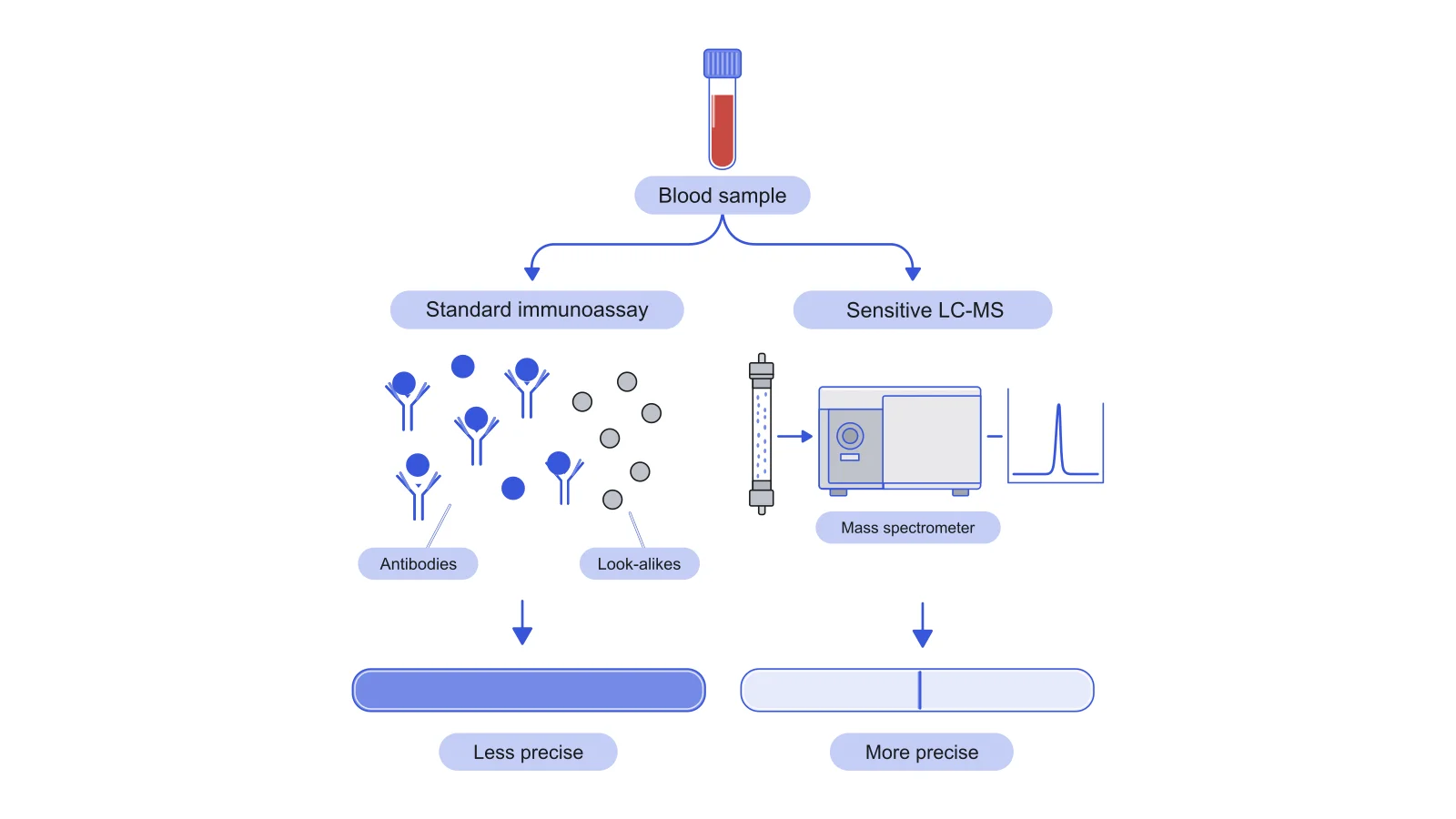
The test type can explain a confusing result, and most men never hear about it. The diagram at the top of this page shows the difference.
Labs measure estradiol in two main ways:
| Standard immunoassay | Sensitive LC-MS/MS | |
|---|---|---|
| How it works | Antibodies bind estradiol and the amount bound is read out | Liquid chromatography separates the sample; a mass spectrometer identifies and counts estradiol |
| Strength | Fast, cheap, fine at the high levels seen in premenopausal women | Specific and accurate at low levels |
| Weakness | At low levels, antibodies can pick up similar molecules; results can be inaccurate | Costs more, not every lab runs it |
| Usual name on a US order | Estradiol | Estradiol, sensitive or ultrasensitive (Labcorp, Quest) |
An immunoassay is a test that uses antibodies to find a substance. LC-MS/MS is a lab method that sorts a sample and weighs its molecules.
The Endocrine Society says most direct immunoassays can’t measure the low estradiol levels in men, children and women past menopause. It says mass spectrometry may be more specific and sensitive there. But even those methods can struggle at the very lowest levels.
If you compare results over time, check they come from the same type of test. Switching methods can change the number with nothing changing in your body. Labcorp’s own test page, for example, warns that results from different methods can’t be swapped for one another in repeat testing.
What do guidelines say about checking estradiol on TRT?
The guidelines say less than forum advice does.
- The AUA recommends checking estradiol before treatment in men with breast symptoms or gynecomastia, and again in men who develop them on therapy. It lists estradiol as optional for all men at the start and at the first testosterone recheck.
- The Endocrine Society schedule centers on testosterone, hematocrit and, for some men, PSA. Estradiol isn’t on its routine list.
- The label for one testosterone cypionate product lists gynecomastia among possible side effects of male hormones.
Many prescribers check estradiol anyway, especially on injections. Whether and how often is their decision. The TRT blood work schedule shows where it fits with the other tests, and the TRT blood work hub covers the rest of the panel.
What symptoms are linked to estradiol?
Breast tenderness or swelling under the nipple is the symptom most clearly tied to estradiol. It’s the main reason guidelines mention it. If you notice it, tell your prescriber.
Other symptoms often blamed on “high E2” online, such as moodiness, water retention or low libido, have many possible causes. These include testosterone itself, sleep, stress and other medicines.
And as the study above showed, low estradiol can also reduce libido. A symptom plus a single number isn’t enough to know which way to go. For the wider list of effects to watch, see the guide to TRT side effects.
What is gynecomastia, and when should you call your prescriber?
Gynecomastia is growth of breast gland tissue in men. It usually feels like a firm, rubbery, sometimes tender disc right under the nipple, on one side or both. It’s listed among possible side effects of male hormones, and it’s the main reason the AUA mentions estradiol at all.
Tell your prescriber if you notice new tenderness or swelling. The National Cancer Institute lists these signs of male breast cancer:
- a lump or thickening in or near the breast
- a nipple that changes shape or turns inward
- fluid from the nipple that may be clear or bloody
- dimpling of the skin
- scaly, red or swollen skin on the breast or nipple
- an open sore
Fewer than 1 in 100 breast cancers in the US occur in men, and many breast changes in men are harmless. But any of these signs deserves a proper exam.
Does the testosterone-to-estradiol ratio matter?
Not as a target. Forums often talk about a “T to E2 ratio” as if there’s a right number. Neither the Endocrine Society nor the AUA sets a ratio target for men on testosterone therapy.
The AUA mentions ratios only for fertility in specific conditions. A 2025 review found little data on the ratio in men on testosterone. It noted that tests and timing limit its use, and said the best value is not known.
What the ratio does capture is real: estradiol and testosterone move together, so it makes sense to read them side by side. Just treat a ratio from a forum as an idea to discuss, not a target.
How often is estradiol checked on TRT?
There’s no guideline schedule for estradiol on treatment, so it’s up to your prescriber. Common reasons to check it include breast tenderness or swelling, a change in product, route or schedule, and an unexpected past result.
When you recheck, keep as much the same as you can: the same lab, the same test method and the same timing after your injection. Otherwise a change in the number may say more about the test than about you.
Why might your estradiol result and your symptoms not match?
It’s common to feel fine with an estradiol flagged high, or to feel off with a result in range. Several things can explain the mismatch:
- The test method. A standard immunoassay can be wrong at male levels.
- The timing. A draw near an injection peak shows a higher estradiol than one at the trough.
- The cause of the symptom. Mood, energy and libido are affected by many things besides estradiol.
- Individual differences. Men differ in how they respond to the same level.
That’s why prescribers look at the method, the timing, testosterone and symptoms together. They often recheck before changing anything.
What might your prescriber consider if estradiol looks high?
Usually the first step is to confirm the number. Which test was used, when was the blood drawn, what was your testosterone, and how do you feel? Many prescribers recheck before changing anything.
Neither the Endocrine Society nor the AUA recommends medicines that lower estradiol as a routine part of testosterone therapy. For breast symptoms that start on treatment, the AUA suggests watching for a while first, because they sometimes go away on their own.
Pushing estradiol down has costs too. In the studies above, low estradiol meant more body fat, lower sex drive and weaker bone protection. Whether any treatment change is needed is for you and your prescriber to decide, based on symptoms and accurate, well-timed labs.
Don’t start, stop or change any medicine on your own because of an estradiol number.
How do you prepare for an estradiol test?
A little preparation makes the result much easier to read:
- Ask which test is being ordered. If you’re a man on TRT, it’s fair to ask whether it’s the sensitive (LC-MS/MS) version.
- Confirm the timing. Ask your prescriber if they want the draw at your trough, at the midpoint or on a set day after your injection. Then stick to it every time. Our blood test timing tool can show the window.
- Test testosterone on the same draw. Estradiol on its own is hard to read. With testosterone from the same sample, it makes sense.
- Use the same lab when you can, so the method and range stay the same.
- Write down what’s unusual: a missed or late injection, a recent illness, a big change in weight or training, or a new medicine or supplement. Tell your prescriber about all of them.
How do you read an estradiol result?
- Check the units. US labs usually report pg/mL; many other countries use pmol/L. They can’t be swapped for one another.
- Check the method. Is it a sensitive (LC-MS/MS) test or a standard immunoassay?
- Check the range printed on your report. Ranges for men differ between labs and methods.
- Note the timing after your last injection.
- Read it with testosterone. The two move together, so look at total testosterone and, if measured, SHBG from the same draw.
What should you ask your prescriber about estradiol?
- Which estradiol test did you order, sensitive or standard?
- Is my result in range for that test, and how does it compare with my testosterone?
- Was the timing of the draw what you wanted?
- Are my symptoms likely to be related to estradiol, or to something else?
- Do you want to recheck it, and when?
How can you track estradiol over time?
Estradiol only makes sense in context. For each result, record the date, the value with its unit, the test method and the lab’s range. Add your testosterone from the same draw, and how many days it was after your last injection.
A few draws recorded that way show whether a high number was a real trend or just a peak-day draw on a less precise test. Other markers to keep alongside it include hematocrit.