

What is trough testosterone, and how is it different from peak and midpoint?
Trough testosterone is your level right before your next injection, when it is at its lowest. The peak is the highest level, a day to a few days after the injection. A midpoint draw falls halfway between two injections.
All three are the same blood test, drawn at different times. This page explains what each number means. Our guide to how TRT levels move shows the bigger picture.
Timing matters because injected testosterone doesn’t stay flat.
After an intramuscular (IM) injection, which goes into the muscle, testosterone rises above the normal range. Then it falls slowly toward the low range by the end of the interval, the Endocrine Society says. The same guideline says these “peaks and valleys” may line up with changes in how you feel.
So a number on its own says little. A result of 450 ng/dL (nanograms per deciliter, the usual US unit) means one thing the day before an injection and something else two days after it. Knowing which draw you had is the first step to reading it.
How soon after an injection does testosterone peak?
The peak comes within hours to a few days of the injection. The exact time depends on the product, the route and the amount.
- IM cypionate. In a 1987 study of 11 men with low testosterone given 200 mg cypionate injections, levels peaked between days 2 and 5. They stayed above normal in many men between days 2 and 7, and were back to their starting level by days 13 to 14.
- IM enanthate. In the comparison group of a small trial, 10 men on IM enanthate every two weeks peaked about 33 hours after the injection, on average.
- SubQ enanthate (Xyosted). SubQ means under the skin. The drug label reports a median peak about 12 hours after the weekly dose.
The wide ranges are the point: people differ, and so do products. Why cypionate peaks when it does, and how long it lasts, is covered in cypionate half-life. For blood tests, what matters is that the peak comes early in the interval and the low point comes at the end.
When are peak, midpoint and trough blood draws taken?
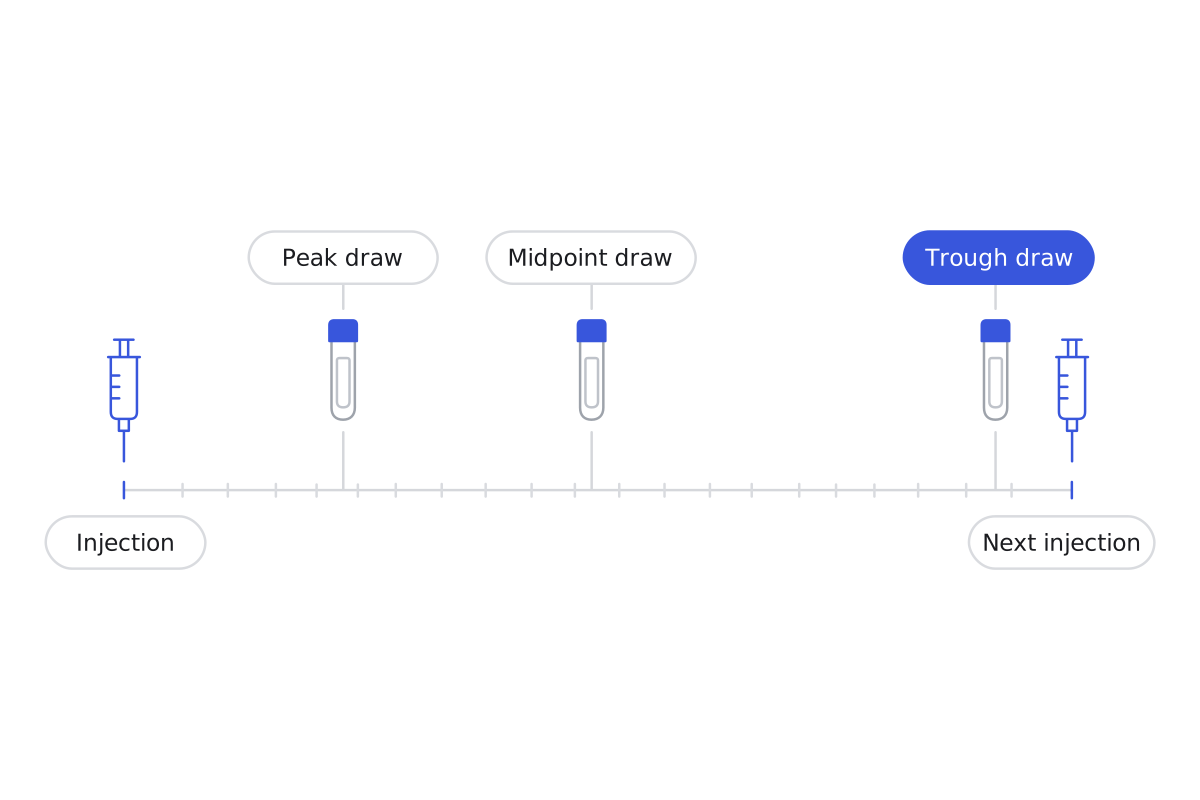
Three draw times within one injection interval. Only the trough sits right before the next injection.
- Peak draw: early in the interval, when the level is highest. The AUA (American Urological Association) guideline says a peak level 18 to 36 hours after an injection may be useful. Side effects such as a high red-cell count are likely at least partly tied to the peak.
- Midpoint draw: halfway through the interval, for example day 3 or 4 of a weekly schedule. The Endocrine Society tells prescribers to use this for cypionate and enanthate.
- Trough draw: at the end of the interval, before the next injection. The AUA describes it as “measured prior to injection.” It can show whether levels stay in range for the whole cycle.
On a trough day, the blood draw comes first and the injection after. If the injection comes first, the result is no longer a trough. Your prescriber decides which draw they want; the lab only takes the sample.
What do the guidelines tell prescribers about draw timing?
The two main US guidelines don’t fully agree. It helps to know that before you compare advice online.
The Endocrine Society (2018) tells prescribers to check testosterone 3 to 6 months after starting. For injectable cypionate or enanthate, it says to “measure serum T concentrations midway between injections.” It also says the timing of checks depends on the formulation. After that, it suggests testosterone and hematocrit (the share of your blood made up of red cells) at 12 months and then yearly.
The AUA (2018) is more cautious. It says no data exist on the best time to draw blood within a cycle, and that mid-cycle testing became the habit mostly for convenience. It adds that a mid-cycle draw on day 3 or 4 “has no ability to define peak and trough levels.” The AUA also suggests waiting at least three to four injection cycles before the first check.
Neither guideline tells you, the patient, which draw to ask for. They are written for prescribers, who weigh your product, schedule, symptoms and other labs such as hematocrit and estradiol.
What do the drug labels say about when to test?
Labels are the FDA-approved instructions for each product, and they vary. Some give a clear draw time; the main cypionate label gives none.
| Product (route) | What the label or guideline says about timing |
|---|---|
| Cypionate or enanthate injection (IM) | No draw time on the DEPO-Testosterone label; Endocrine Society: midway between injections |
| Xyosted, enanthate auto-injector (SubQ, weekly) | Trough: 7 days after the most recent dose, after 6 weeks of treatment |
| Testosterone undecanoate injection (IM) | Endocrine Society: at the end of the interval, just before the next injection |
| AndroGel 1.62% (gel, daily) | Label: the morning level before that day’s gel; Endocrine Society: 2 to 8 hours after applying |
| Kyzatrex (oral) | 3 to 5 hours after the morning dose |
| Jatenzo (oral) | 6 hours after the morning dose |
The DEPO-Testosterone label does ask for hemoglobin and hematocrit to be checked from time to time. Note too that the gel label and the guideline disagree on gel timing. If your product isn’t on this list, your pharmacist can point you to the timing section of its label.
How much can the number change depending on the day you test?
A lot, especially with injections spaced further apart. Studies that sampled blood across a whole interval show the size of the swing:
- In that IM enanthate group, the average peak was about 2,262 ng/dL and the average low point about 466 ng/dL. That is roughly a fivefold difference within two weeks.
- In a 1999 study, men on IM enanthate every two weeks had above-normal testosterone for several days after each injection.
- With weekly Xyosted, the average peak at week 12 was 790 ng/dL and the average low point 436 ng/dL, a much smaller gap.
To show the shape for a common schedule, here is the TRTracker app’s level model for weekly cypionate once levels have settled. It is an estimate for an average person, not a measurement.
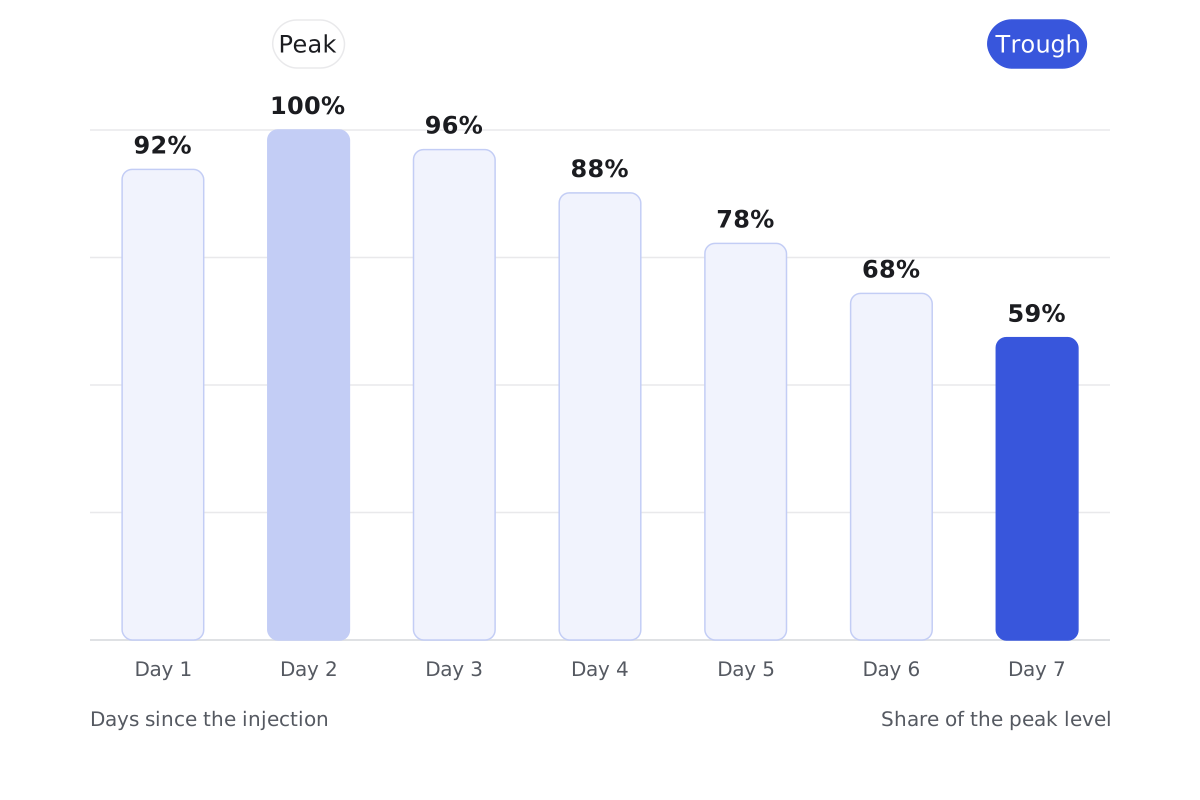
Estimated level on each day after a weekly cypionate injection, as a share of the peak, from the app’s level model. Your own curve will differ.
In that model, a draw on day 7 reads about 59% of the day-2 peak. So two honest results a few days apart can look like a big change when nothing changed at all. You can try other schedules in the free level calculator.
Does SubQ or a shorter interval change peak and trough?
Usually the swing gets smaller, though the evidence is limited. In a small study of 11 transgender men on weekly SubQ cypionate, total testosterone stayed fairly stable across the week. That group was small and not the same as men with low testosterone, so treat it as a hint, not proof.
Spacing injections closer together also flattens the curve. A 1980 study compared IM enanthate given weekly, or every 2, 3 or 4 weeks. All four schedules stayed largely in the normal range, and the weekly schedule had the highest average level between injections.
How schedules compare, and why the choice is your prescriber’s, is covered in injection frequency. How SubQ works is covered in our guide to SubQ testosterone.
Should you test in the morning or fasting while on TRT?
The guidelines differ, and both mostly talk about diagnosis. The Endocrine Society advises a morning test after an overnight fast when diagnosing low testosterone, because food and glucose lower the level. The AUA says clinicians should not insist on fasting.
Neither sets a separate morning or fasting rule for checking levels on injections. Many prescribers still book morning draws so results are easy to compare. Follow your prescriber’s and the lab’s instructions, and keep the time of day the same from draw to draw if you can.
Can you feel the trough, and does it match the number?
Some people can. The Endocrine Society notes that the peaks and valleys of injections “may be associated with fluctuations in symptoms.” Forum users often call the end-of-cycle dip a “crash”: lower energy, mood or sex drive in the last day or two before the next shot.
The AUA guideline uses the same word. It describes large differences between peak and trough that can leave patients feeling symptoms toward the end of the cycle, even when their trough level is still in range. In other words, a normal trough number doesn’t rule out a real end-of-week dip, and a dip in how you feel doesn’t prove a low level.
Feelings have plenty of other causes too: sleep, stress, alcohol, illness, a hard week at work. That’s why the pattern matters more than one bad day.
If you notice the same dip at the same point in every cycle, write down the day, how many days it was since your injection, and what you felt. A short log over a few weeks gives your prescriber something concrete to weigh against your lab results. It’s their job to decide whether anything should change.
How do you compare results taken at different times?
Compare like with like. A trough with a trough, a midpoint with a midpoint. For each draw, write down:
- Date and time of the draw.
- Date and time of your last injection, and the days or hours in between.
- Which draw it was meant to be: peak, midpoint or trough.
- Product, route and schedule at the time, such as cypionate, IM, weekly.
- The lab, because different labs and methods give different numbers.
With those notes, a change in your total testosterone result can be read for what it is. Without them, you and your prescriber are guessing whether it was the treatment or the calendar. When to book each check over your first year, and what else is usually tested, is in our TRT blood work schedule.
If your levels were checked very early, they may not have settled yet. With weekly injections, levels build up over the first few weeks, and the half-life guide shows why. That is one reason the AUA suggests waiting at least three to four cycles before the first check.
What should you ask your prescriber about trough and peak testing?
- Which draw do you want: peak, midpoint or trough? How many days after my injection?
- On a trough day, should I wait to inject until after the blood draw?
- Should I go in the morning, and should I fast?
- If my result is near the edge of the range, would a draw at a different time help?
- Which other labs, such as hematocrit, do you want at the same draw?
Don’t change your injections because of one number. If you feel very unwell, have chest pain, trouble breathing, or swelling or pain in one leg, get emergency help. For new or worrying symptoms between visits, call your prescriber.