
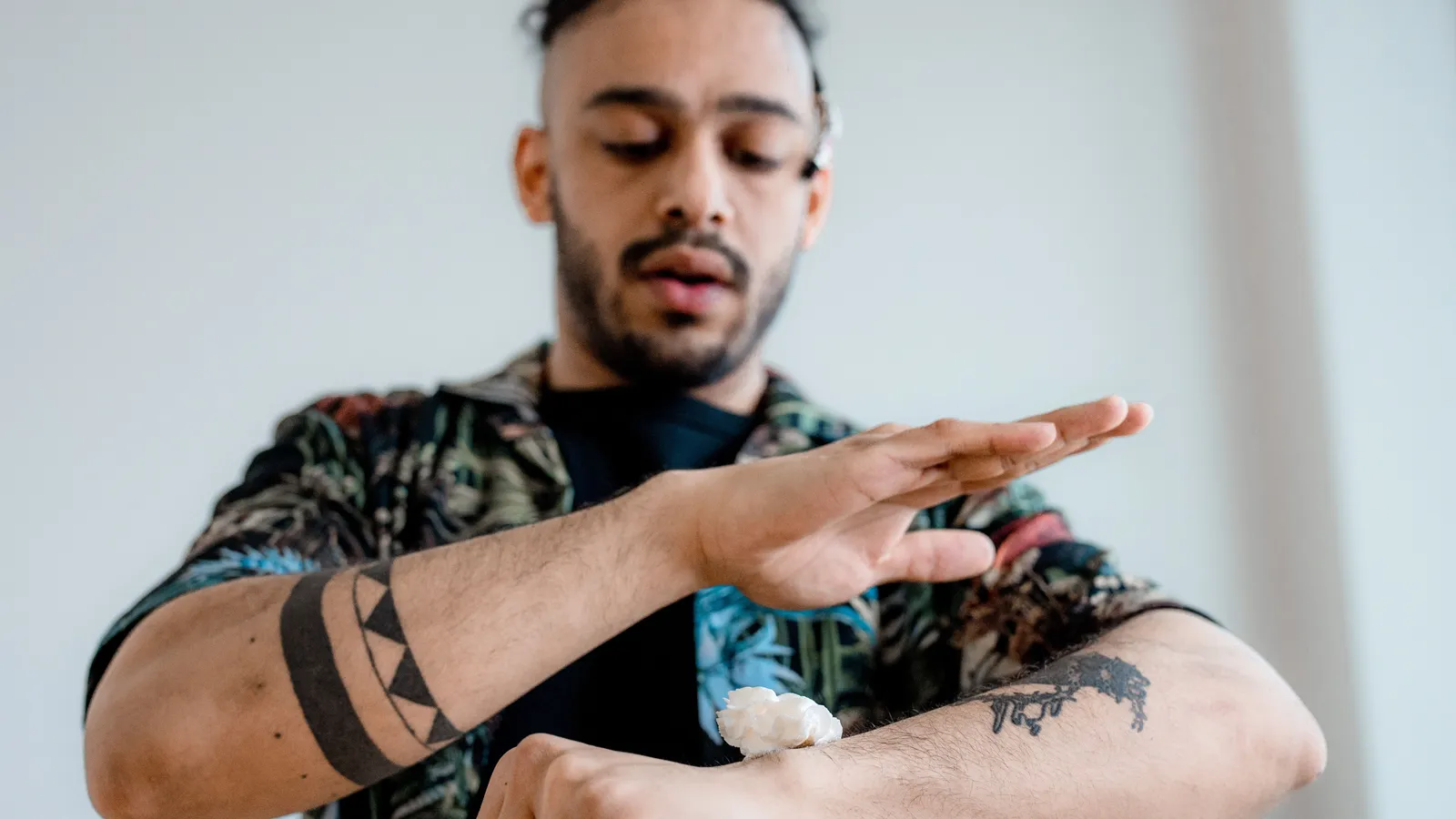
Is testosterone gel or injection better?
Testosterone gel vs injections is a trade-off, not a contest. The Endocrine Society tells prescribers to aim for mid-normal levels “with any of the approved formulations”. The choice rests on patient preference, how each product behaves in the body, side effects, treatment burden and cost.
Both work; they work differently. For the bigger picture of how injected testosterone rises and falls, see our guide to how TRT levels move.
In short, daily gel gives steadier levels and is linked to smaller rises in red blood cells. But it can transfer to others by skin contact, and brand gel costs more. Injections are inexpensive as generics and reach normal levels reliably, but levels rise and fall between shots.
This guide compares them point by point. The decision stays with you and your prescriber.
| Testosterone gel | Testosterone cypionate or enanthate injection | |
|---|---|---|
| How often | Daily, on the skin | Usually every 1 to 2 weeks, by injection |
| Levels | Steady day to day; vary between applications | Peak a few days after a shot, then fall |
| Hematocrit | Rises, a little less on average | Rises, a little more on average |
| Main extra risk | Transfer to partners and children | Injection-site pain and needles |
| Blood test timing | 2 to 8 hours after applying (Endocrine Society) | Midway between injections (Endocrine Society) |
| Cost (Medicare data) | Generic: low hundreds per fill; brand much more | Generic: tens of dollars per fill |
How do testosterone levels differ on gel and injections?
Gel delivers testosterone through the skin every day. AndroGel 1% reaches steady state by the second or third day, which is when your levels settle into a repeating pattern. About 10% of the applied testosterone is absorbed.
The Endocrine Society lists “less fluctuation of T concentrations than T enanthate or cypionate” among gel’s advantages. The AUA, the American Urological Association, gives a higher absorption estimate of 13 to 20% from studies.
Injections of testosterone cypionate or enanthate work differently. After a single injection, levels rise above the normal range. They then decline toward low levels by the end of the dosing interval, according to the Endocrine Society.
In one small study of a single cypionate injection, testosterone peaked on days 2 to 5 and returned to baseline by days 13 to 14. Cypionate’s half-life is about eight days. The half-life is the time your body takes to clear half of a dose.
Weekly injections under the skin follow a gentler version of the same pattern. With Xyosted, levels peaked a median of about 12 hours after each dose and reached steady state by week 6.
Only one small study compared the two directly in the same men. In 24 men who switched from injections every week or two to daily gel, peak free testosterone was lower on gel. The swing between peak and trough was much smaller.
The trough is the lowest level, just before the next dose. That study wasn’t randomized and the men had HIV, so treat it as a pointer, not proof.
How often you inject changes the injection curve. Our guide to weekly or twice-weekly shots covers that.
Do gels reach normal testosterone levels?
In most men, yes, but not all. The AUA says topical gels reach normal-range levels in 74 to 87% of men. Injections, it says, “are able to achieve therapeutic levels in almost any clinical scenario”.
In the AndroGel 1.62% trial, 81.6% of men had average levels in the normal range at day 112.
Absorption varies between men, so some need their prescriber to adjust the amount. The gel label also notes that washing the site soon after applying reduces absorption. That’s why it asks you to avoid showering or swimming for at least 2 hours after AndroGel 1.62%.
In the label’s study, showering 2 or 6 hours after applying lowered average levels by 13% and 12%. Showering at 10 hours had no effect.
The AUA’s caveat on injections is the reverse. Short-acting injections reach the range reliably but can spend longer above and below it than other forms.
Do gels or injections raise hematocrit more?
Every form raises hematocrit, the share of your blood made up of red cells. The best comparison is a network meta-analysis of 29 placebo-controlled randomized trials with 3,393 men. That means it pooled the results of many trials:
Gel raised hematocrit by 3.0 percentage points and cypionate or enanthate injections by 4.0 points on average. Only the difference between injections and patches was statistically significant. Clinic data show a bigger gap.
In one retrospective review, hematocrit above 50% was seen in 66.7% of men on injections versus 12.8% on gels. The injection group was younger and started higher.
The Endocrine Society lists “less erythrocytosis than injectable T” as a gel advantage. Erythrocytosis means too many red blood cells. The AUA says injectable testosterone is linked to the greatest rises.
Either way, hematocrit is checked on every form. Our hematocrit page explains the limits prescribers watch.
Do blood pressure and estradiol differ between gel and injections?
Blood pressure: both forms can raise it slightly. In 24-hour monitoring studies, Xyosted, a weekly injection under the skin, raised average blood pressure by 3.9/1.5 mm Hg after 12 weeks. AndroGel 1.62% raised it by 1.9/1.3 mm Hg after 16 weeks.
These were separate studies, not a head-to-head comparison.
Estradiol, a form of estrogen made from testosterone, rose on both gels and injections in a clinic comparison. Our estradiol page explains what the estradiol number means.
Heart safety: the largest trial, TRAVERSE, tested only a daily gel. Major heart events occurred in 7.0% of men on testosterone and 7.3% on placebo. There were more cases of atrial fibrillation (an irregular heartbeat), acute kidney injury and pulmonary embolism (a blood clot in the lung).
There’s no injection trial of the same size, so we can’t say one form is safer for the heart. Our guide to TRT side effects covers the full picture.
Can testosterone gel affect your partner or children?
Yes, and this is the gel’s biggest practical difference. Testosterone gel carries a boxed warning, the strongest kind the FDA puts on a label.
Children have shown virilization after contact with skin where gel was applied. Virilization means signs of early puberty, such as genital enlargement and pubic hair.
Most signs went away when the exposure stopped, but in a few children they didn’t fully reverse.
In a label study, deliberate skin-to-skin contact with a gel site raised women’s testosterone exposure by up to 280%. Covering the site with a T-shirt or washing it before contact largely prevented transfer in a related study. That study was designed to simulate exaggerated contact.
Another study found transfer could still happen at least 12 hours after applying. So the precautions apply all day, not just right after. Real cases happen: one report describes two young children affected after sleeping in their parents’ bed while their fathers used gel.
The AUA recommends that prescribers discuss transfer risk with every gel user. It says the risk can be reduced by washing hands, covering the site with clothing, and washing the area before close contact. Gel is also contraindicated in women who are pregnant.
DHT: gels also raise DHT, a stronger hormone made from testosterone. The Endocrine Society lists moderately high DHT, of unknown significance, among gel’s drawbacks.
What about skin reactions and injection pain?
Gel: in the AndroGel 1.62% trial, application-site reactions affected 0.9% of men. The AUA reports redness or rash in 3 to 16% across topical products. The AndroGel 1% label names acne among its most common reactions.
Injections: the cypionate label lists pain and inflammation at the injection site. The AUA reports local reactions in 7 to 33% of men on short-acting injections. Under-the-skin injections are another option; our guide to subcutaneous testosterone injections compares them.
Does the form of testosterone affect fertility differently?
Not in a way you can rely on. Every form of testosterone therapy can lower sperm production. Testosterone from outside the body turns down the brain’s signals to the testes.
The ASRM, the main US fertility society, says it’s “generally believed” that shots and pellets are more likely to cause infertility than gels. It adds that any form can disrupt sperm production.
If you might want children, raise it with your prescriber before choosing any form. Our guide to TRT and fertility explains the research and the options to discuss.
When should blood be drawn on gel versus injections?
At different points, because the curves differ. The Endocrine Society measures injection levels midway between injections. It measures gel levels 2 to 8 hours after application, once you’ve used it for at least a week.
Some labels use other points.
The AndroGel 1.62% label adjusts treatment on a morning level before the day’s application. The Xyosted label uses a trough 7 days after the last dose.
Because guidelines and labels differ, ask your prescriber which timing they want, and note it on your lab slip. Our guide to trough testosterone explains the options. The blood test timing tool helps you plan the draw.
Which is easier to stay on, gel or injections?
Many men stop either one. In US insurance claims, only 34.7% of men on topical gels were still using them at 6 months and 15.4% at 12 months. About half of those who stopped later restarted.
In older men in Ontario, the median time before stopping was 319 days on gel and 283 days on injections.
Claims data can’t show why men stop. One claims study concluded that how long men stay on treatment may depend more on their underlying condition than on daily use or the way testosterone is given. Daily application suits some routines; a shot every week or two suits others.
That’s a fair thing to raise with your prescriber. The form you’ll actually keep using is worth more than one that looks better on paper.
Do gel and injections cost different amounts?
Yes, often a lot. In 2024 Medicare data, average gross Part D spending per prescription fill was about $37 for generic testosterone cypionate. It was $168 for generic testosterone (mostly gels), $1,148 for brand AndroGel and $788 for the Xyosted autoinjector.
A fill can cover different lengths of time for each product, so compare the order of magnitude, not exact ratios.
Those are what Medicare plans paid in total, not your out-of-pocket price. The AUA prefers commercially manufactured products over compounded creams and gels when possible. Compounded products aren’t FDA-approved, and their strength can vary.
Our guide to what TRT costs covers insurance, labs and visits too.
What should you ask your prescriber about gel or injections?
- Which form fits my health, my routine and my budget?
- If I use gel, how do I protect my partner and children?
- If I inject, who teaches me, and how often will I inject?
- When should my blood be drawn on this form?
- How will we watch my hematocrit and blood pressure?
- If I want to switch later, how would we time it?
You can see how your own schedule shapes your levels in our free level calculator, an estimate, not a lab result.